

Pulmonary Arterial Hypertension in Canada: Closing the Gaps
“By the time I finally got to a PH clinic, I could barely walk across the room.”
Her story is not unique. Like many Canadians living with pulmonary arterial hypertension, she spent years being told it was asthma, anxiety, or simply being out of shape, while her world became smaller with every flight of stairs she could no longer climb.
Survey data show that half of patients in Canada wait more than two years for a confirmed diagnosis, often enduring repeated misdiagnoses, job loss, and a constant sense of uncertainty about the future.
This report brings together stories like hers, alongside national data and expert insight, to show how late diagnosis, fragmented care and unequal access to therapies shape real lives and what must change to fix it.
Discover the latest insights from leading Canadian and international experts on the state of pulmonary arterial hypertension (PAH) care in Canada, and what must change to ensure that scientific progress truly reaches patients.
Download the Report: “Pulmonary Arterial Hypertension in Canada: Bridging the Gap Between Innovation and Access.”
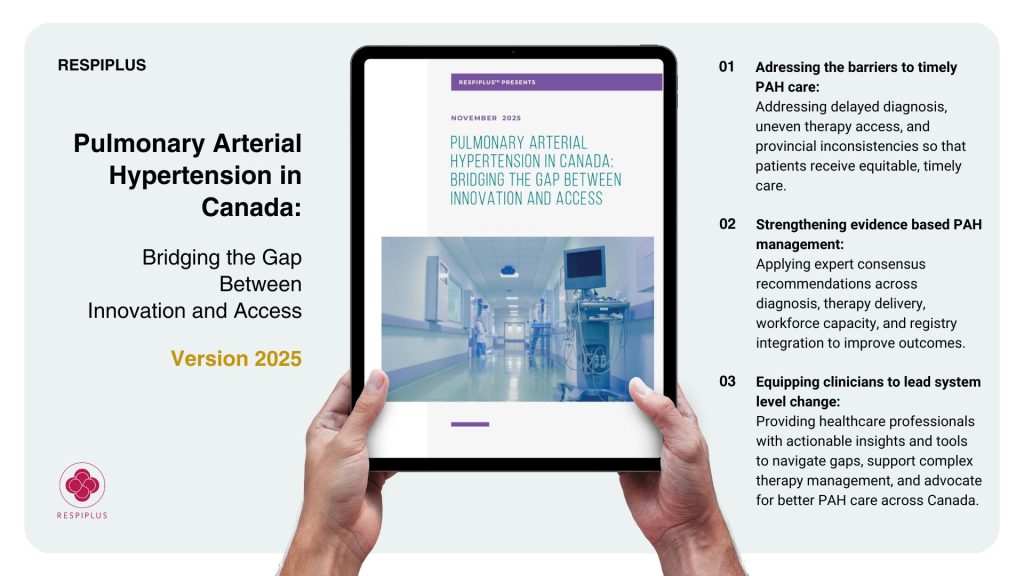
Table of Contents
About the Investigative Report
Despite major advances in treatment, Canadians living with pulmonary arterial hypertension continue to face delayed diagnosis, fragmented care, and uneven access to life-saving therapies.
This investigative report brings together clinicians, policy experts, and patient advocates to examine Canada’s readiness for the next era of PAH care.
Developed through expert interviews, national survey data, and international comparisons, this report highlights the urgent reforms needed to improve outcomes, strengthen health system readiness, and reduce inequities across provinces.
Key Findings
- Diagnostic delays remain critical: Half of Canadian patients wait more than two years for a confirmed diagnosis.
- System readiness lags behind innovation: New therapies like sotatercept are approved but not yet accessible in many regions.
- Workforce shortages limit impact: PH centres deliver world-class care but lack nurses, pharmacists, and social workers to support complex therapy management.
- Registries are underutilized: Canada’s voluntary system prevents data-driven improvements seen in France and Germany.
- Equity gaps persist: Geography and provincial silos dictate access to testing and treatment, disproportionately affecting rural and Indigenous communities.
What You’ll Learn
- The current state of PAH care in Canada, including survival trends, system barriers, and therapy access.
- Expert consensus recommendations for reform in six key areas: diagnosis, workforce, therapy delivery, registry integration, education, and equity.
- Actionable insights for policymakers, clinicians, and advocates working to close the gap between innovation and access.
Who Should Read This Report
This investigation is pertinent reading for:
- Respirologists, cardiologists, and internists managing pulmonary hypertension
- Policy leaders and administrators in health ministries or payer organizations
- Patient advocacy organizations and allied health professionals
- Healthcare decision-makers involved in rare disease and chronic care planning
Contributors
The white paper was developed through collaboration with leading Canadian experts, including:
- Dr. Jason Weatherald, University of Alberta (Scientific Planning Committee Chair)
- Dr. Paul Hernandez, Canadian Thoracic Society (CTS)
- Dr. Nathan Brunner, Canadian Cardiovascular Society (CCS)
- Dr. David Langleben, McGill University
- Dr. Alan Kaplan, Family Physician Airways Group of Canada (FPAGC)
- Jennifer Lee, Canadian Society of Echocardiography (CSE)
- Jamie Myrah, Pulmonary Hypertension Association of Canada (PHA Canada)
- Beth Slaunwhite, Patient Expert
- María Sedeno, Respiplus
- Katrina Metz, Respiplus
We extend our sincere thanks to the organizations whose expertise and collaboration contributed to the development of this report: Canadian Thoracic Society (CTS), Canadian Cardiovascular Society (CCS), Family Physician Airways Group of Canada (FPAGC), Pulmonary Hypertension Association of Canada (PHA Canada).
Their commitment to advancing pulmonary arterial hypertension care in Canada was essential to this work.




About RESPIPLUS™
RESPIPLUS™ is a non-profit organization dedicated to advancing respiratory health through evidence-based education and system change.
This report was developed by RESPIPLUS™, with the contribution of leading Canadian and international experts and with support from an independent educational grant from Merck Canada.


Download the Full Report
Gain insight into how we can transform the promise of medical innovation into equitable, accessible care for all Canadians living with PAH.
Related Resources
Continue exploring pulmonary hypertension care and education through our latest learning initiatives and expert-led programs:
The eXpand Podcast Season 6: Pulmonary Arterial Hypertension
Conversations with leading clinicians and advocates shaping the future of PAH care in Canada.
Episode 1 | Why Is Pulmonary Hypertension Still Misdiagnosed? (with Jamie Myrah)
Exploring the reasons behind delayed diagnosis and how awareness can drive earlier detection.
Understanding Pulmonary Hypertension Classes: A Comprehensive Guide
A clear overview of WHO PH classification and its clinical implications.
Living with Pulmonary Hypertension: Daily Management Tips
Practical strategies to improve daily life and emotional well-being.
Pulmonary Hypertension: The Importance of Early Diagnosis and Treatment
How timely detection and multidisciplinary care can change patient outcomes.
Learn More About Pulmonary Hypertension
For a deeper understanding of pulmonary hypertension, including causes, symptoms, diagnosis, and treatment strategies, visit our comprehensive educational page:
Continue Learning: Accredited Course on Pulmonary Arterial Hypertension (PAH)
For healthcare professionals looking to deepen their expertise in pulmonary arterial hypertension, we offer a free, accredited online course designed to strengthen diagnostic confidence and improve treatment decision-making.
PAH in Practice: A Case-based Online Learning Program for Better Patient Care
This is a concise, case based learning program that covers:
- Early identification of high risk patients
- Key diagnostic tools and referral pathways
- How to distinguish PAH from other PH groups
- Evidence based treatment strategies and follow up
- Practical scenarios to apply guideline based care
This activity is an Accredited Section 3 Self-Assessment Program (Royal College MOC), developed in collaboration with leading Canadian experts.
This program is co-developed by the Canadian Thoracic Society, Respiplus and Merck and is planned to achieve scientific integrity, objectivity and balance.
The course is available until September 30th 2026 and is offered in English only.
Frequently Asked Questions (FAQ) about Pulmonary Arterial Hypertension
What is pulmonary arterial hypertension (PAH)?
Pulmonary arterial hypertension is a form of pulmonary hypertension in which the small arteries in the lungs become narrowed, thickened or stiff. This raises the pressure in the pulmonary arteries and forces the right side of the heart to work harder, which can eventually lead to right heart failure if it is not treated.
What causes pulmonary arterial hypertension?
There is no single cause of pulmonary arterial hypertension. PAH can be:
- Idiopathic (no identifiable cause)
- Heritable, due to genetic variants such as BMPR2
- Drug or toxin induced, for example certain appetite suppressants
- Associated with other diseases, such as connective tissue diseases, congenital heart disease, portal hypertension, HIV infection or congenital heart defects (shunts).
In many patients, PAH is the result of several factors combined.
What are the WHO pulmonary hypertension groups?
The World Health Organization (WHO) classifies pulmonary hypertension into five groups based on the underlying cause:
- Group 1: Pulmonary arterial hypertension (PAH)
- Group 2: Pulmonary hypertension due to left heart disease
- Group 3: Pulmonary hypertension due to lung diseases or low oxygen
- Group 4: Chronic thromboembolic pulmonary hypertension (CTEPH)
- Group 5: Pulmonary hypertension with unclear or multifactorial mechanisms
What is the difference between pulmonary hypertension and pulmonary arterial hypertension?
“Pulmonary hypertension” is a broad term that means high blood pressure in the blood vessels of the lungs from any cause.
“Pulmonary arterial hypertension” is a specific subtype (WHO Group 1) where the problem is mainly in the small pulmonary arteries themselves. All PAH is pulmonary hypertension, but not all pulmonary hypertension is PAH. Correctly identifying the group matters because the tests, treatments and prognosis can be very different.
What are the symptoms of pulmonary arterial hypertension?
Common symptoms of PAH include:
- Shortness of breath, especially with activity
- Fatigue and reduced exercise capacity
- Dizziness or fainting
- Chest discomfort or chest pain
- Palpitations
- Swelling of the legs, ankles or abdomen in more advanced stages
Symptoms often develop slowly and can be mistaken for asthma, deconditioning or anxiety, which contributes to delayed diagnosis.
How is pulmonary arterial hypertension diagnosed?
Diagnosis usually requires:
- Medical history and physical examination
- Echocardiogram (heart ultrasound)
- Blood tests and lung function tests
- Imaging of the lungs (CT or ventilation perfusion scan)
- Right heart catheterization, which directly measures pressures in the pulmonary arteries and is the gold standard to confirm PAH and assess severity.
Because the workup is complex, people with suspected PAH are typically referred to specialized pulmonary hypertension centers.
Can pulmonary arterial hypertension be reversed?
Pulmonary arterial hypertension is generally a chronic, progressive disease. At present, PAH is considered not curable and usually cannot be fully reversed. However, modern treatments can improve symptoms, exercise capacity and survival, and in some patients disease progression can be slowed significantly or partially reversed on a functional level.
In rare situations where PAH is caused by another condition that can be treated effectively, marked improvement is possible, but this needs specialist care.
What is the life expectancy of someone with pulmonary hypertension?
Life expectancy in pulmonary hypertension, and specifically PAH, has improved with modern therapies but still varies a lot from person to person.
Recent studies of PAH show:
- Median survival around 6 to 7 years after diagnosis in many cohorts
- Five year survival rates often in the range of 50 to more than 70 percent, depending on the cause, risk profile, response to treatment and access to specialized care.
These numbers are averages, not predictions for any individual. A pulmonary hypertension specialist can give more personalized information based on detailed risk assessment.
What is the best treatment for pulmonary hypertension?
There is no single “best” treatment for pulmonary hypertension or PAH. The right approach depends on the type of pulmonary hypertension, its severity and the underlying cause. For PAH, guideline based therapy typically combines:
- Drugs that target the endothelin pathway (endothelin receptor antagonists)
- Drugs that target the nitric oxide pathway (PDE5 inhibitors or soluble guanylate cyclase stimulators)
- Drugs that target the prostacyclin pathway (prostacyclin analogues or receptor agonists)
- Supportive treatments such as diuretics, oxygen when indicated and supervised rehabilitation
Treatment decisions should always be made with a pulmonary hypertension specialist.
What doctor treats pulmonary arterial hypertension?
Pulmonary arterial hypertension is usually managed by:
- Pulmonologists or cardiologists with expertise in pulmonary hypertension
- Multidisciplinary teams in specialized pulmonary hypertension or pulmonary vascular disease centers
These teams coordinate diagnostic testing, advanced therapies and long term follow up.
Can smoking cause pulmonary arterial hypertension?
Smoking is a well known risk factor for lung disease and cardiovascular disease. There is growing evidence that tobacco smoke exposure can contribute to pulmonary vascular damage and may increase the risk of pulmonary arterial hypertension in some people, in addition to clearly increasing the risk of pulmonary hypertension related to chronic lung disease.
Even if smoking is not the only cause, quitting smoking is strongly recommended for anyone with pulmonary hypertension or at risk of the condition.
What is end stage pulmonary hypertension?
End stage pulmonary hypertension refers to advanced disease where the right side of the heart is severely weakened and symptoms are present even at rest. People at this stage may have:
- Severe shortness of breath with minimal activity
- Marked swelling, abdominal fluid and low blood pressure
- Frequent hospitalizations for right heart failure
Management focuses on intensive medical therapy, evaluation for lung or heart lung transplantation when appropriate, and palliative and supportive care to relieve symptoms and maintain quality of life.