

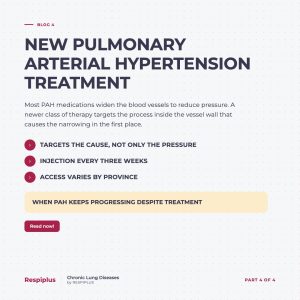
New Pulmonary Arterial Hypertension Treatment Options
When PAH keeps progressing despite treatment, a newer class of therapy works on the cause of the vessel narrowing rather than only its effects. What has changed.
Every so often, a COPD diagnosis reminds you that symptoms are not the whole story.
Amina did not seem like someone who had spent months dealing with unexplained breathlessness. She works in a preschool and is around children all day. You could almost picture her sitting on a classroom rug, reading a picture book and giving every character its own voice.
She was full of energy and rarely sat still. She was young and healthy by most standards. That was the part that made her shortness of breath feel like a mismatch from the start.
It began quietly. She noticed she would become winded lifting toddlers into their chairs or moving quickly between classrooms. Nothing dramatic. Nothing that sounded like a “red flag.” She blamed long days, poor sleep, age, and maybe the winter air. Many people would do the same.
Then a cough set in. It was not forceful, just stubborn. The kind of cough that hangs on in the background. Bronchitis showed up twice in less than a year. She would recover, feel hopeful, and then slip backward again.
Her family doctor did what most clinicians would do. Start with the familiar possibilities. Was it mild asthma? Low iron? Stress? Some mix of exhaustion and daily life catching up? All good guesses. All very reasonable.
COPD was not even in the conversation.
Months went by like this. Symptoms increased and worsened, with some basic testing here and there, but nothing landed with certainty. And there was Amina, sitting on the edge of yet another exam table, feeling like her body was not acting the age it was.
When a spirometry test eventually revealed an airflow obstruction, the room went still. COPD. At 41. In a never-smoker. No major exposures. No known family history of lung disease.
It felt out of place. Not impossible, but unusual in a way that should have prompted one more question.
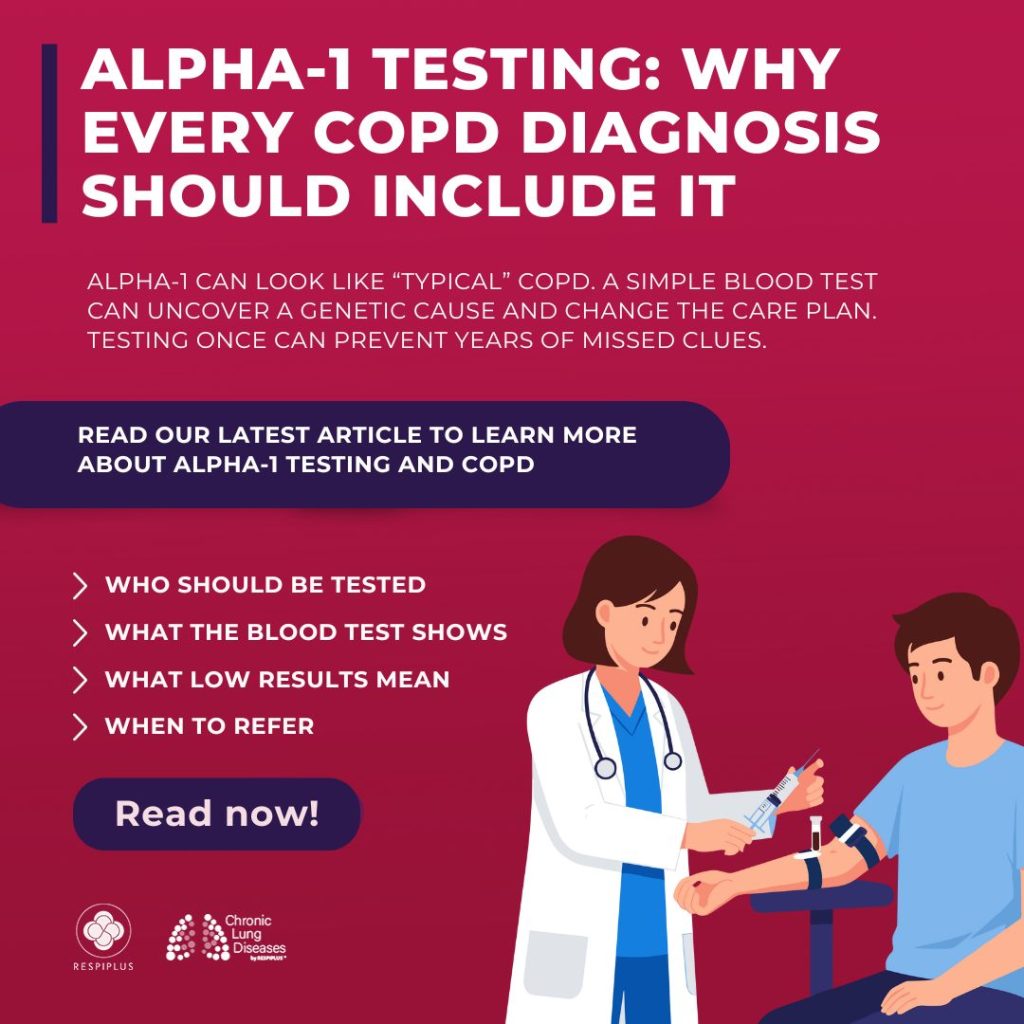
After the diagnosis was made, the plan stayed straightforward. Start COPD inhalers. Monitor symptoms. Reassure her that COPD can be managed. It was a calm, standard approach that fits many people very well.
But something else remained quiet in the background: testing for alpha-1 antitrypsin deficiency, often called Alpha-1.
It was not overlooked out of disinterest or negligence. It simply did not register as a next step because Amina did not fit the picture many of us still carry. COPD is often first associated with a smoking history. When that detail is missing, the mind searches for other explanations before it considers genetics.
For Amina, that gap meant weeks of uncertainty. It also meant that a condition that could have been identified early was still hiding.

Everything changed the day her family physician referred her to a respirologist. Not because anything dramatic had shown up on her tests, but because she was not improving despite treatment. The inhalers helped a little, then stopped helping. The cough persisted. The breathlessness kept creeping back. Something was not adding up.
Her respirologist asked three quiet questions.
“Any relatives with early lung or liver problems?”
Amina paused. “My uncle had liver disease. He died young. Nobody ever really understood why.”
Do your symptoms seem to be progressing faster than they should?
She nodded. “Every time I bounce back, I get sick again.”
“And you have never smoked?”
“No, never.”
There was a brief moment, just a few seconds, when he leaned back in his chair and let those answers settle. That was the moment the story changed direction.
Her symptoms did not map neatly onto asthma or typical COPD. They pointed somewhere else, perhaps something genetic.
Her respirologist ordered a simple blood test: a serum alpha-1 antitrypsin level. No special tube. No complex protocol. Something that can be sent with routine lab work from primary care.
When the results came back, her alpha-1 level was low.
And it all made sense.
Amina’s story is not dramatic. That is what makes it so important. She is not an exception. She is one of many people whose COPD story does not fit the usual picture.
A single blood serum test could have connected the dots months earlier. It could have given her healthcare team a clearer map and given her family information they did not know they needed.
If you diagnose COPD, it is essential to check for Alpha-1 at least once, especially in cases of early onset, unusual severity, faster progression, exacerbations that seem disproportionate, or lung damage that doesn’t match the risk profile. These are subtle signals that something else might be going on.
Smoking history does not rule Alpha-1 in or out. Sometimes it does the opposite. It amplifies the damage, so the mismatch between exposure and severity becomes the real clue. A long smoking history can make Alpha-1 easier to miss, not easier to see.

A low alpha-1 level does more than identify a condition. It changes the plan. It prompts earlier referral to respirology, closer monitoring of lung function, and conversations about how to protect the lung tissue that remains. It also opens the door to therapies and supports that are specific to Alpha-1, rather than treating it as “just COPD.”
For families, it can be a turning point. A confirmed Alpha-1 diagnosis invites careful discussion about family testing, including the option for relatives to know their own risk and act earlier in life. These conversations need to be handled with care, with attention to confidentiality and to the emotional weight that genetic information can carry. But having the information is often better than living with an unexplained illness.
For Amina, finally identifying the cause was not frightening. It was a relief. “At least now I know what I am fighting,” she said. That clarity became the starting point of a more stable chapter.
For clinicians, adding one simple step can make a significant difference. If you diagnose anyone with COPD, include a serum alpha-1 antitrypsin test in the workup. If the level is low, confirm the diagnosis and plan the next steps, such as referring to a respirologist.
It is a small step. It fits within the reality of any busy practice. And for people like Amina, it can change the story from months of uncertainty to an earlier, clearer answer and treatment options.
Alpha-1 is an inherited condition where the body has too little functional alpha-1 antitrypsin, a protective protein made mainly in the liver. This protein helps protect lung tissue from inflammation-related damage. When levels are low, lung damage can build slowly over years and cause COPD. Some people also develop liver problems because abnormal protein can build up in the liver.
Alpha-1 antitrypsin acts like a protective shield for the lungs. During infections, smoke exposure, or irritation, inflammation enzymes can damage healthy lung tissue. Alpha-1 helps keep that damage in check. Without enough functional protein, the lungs are more vulnerable to cumulative injury, which can lead to early emphysema or COPD-like changes. In some forms of Alpha-1, protein can also stress the liver.
Alpha-1 is one of the most common inherited conditions linked to COPD, but it is still underdiagnosed. It is missed because symptoms overlap with asthma and COPD, and smoking history can distract from genetic causes. Many people are diagnosed only after years of symptoms or repeated exacerbations. A simple blood serum level test can diagnose Alpha-1 earlier and change the care plan.
Yes. Smoking does not cause Alpha-1, but it can accelerate lung damage in people who have it, even with a relatively small smoking history. Some people with Alpha-1 have few or no symptoms for years, especially if they avoid smoking and reduce exposures. That is why family testing and early detection can matter: it supports prevention before major lung function is lost.
No. Alpha-1 can affect the liver because abnormal alpha-1 protein may build up in liver cells instead of being released into the bloodstream. Some people develop elevated liver enzymes, fibrosis, cirrhosis, or other liver complications. Not everyone with Alpha-1 will have liver disease, and severity varies by genetic type and other factors. Clinicians may monitor liver health as part of overall care.
Start with the simplest goal: do not miss a genetic contributor to lung damage. Alpha-1 testing is usually a serum blood level first, followed by confirmatory testing if low. Key context includes age at diagnosis, smoking or exposure history, rate of progression, and family history of lung or liver disease. These details affect how strongly results change the plan.
Many professional associations, such as the Canadian Thoracic Society, encourage testing in all people with COPD because the clinical “look” can be misleading. It is especially important in early onset COPD (often under 45 to 50), never-smokers, disproportionate emphysema, frequent exacerbations, or faster-than-expected decline. Testing once can prevent years of treating symptoms without addressing the driver.
Usually both, in sequence. The first step is commonly a serum alpha-1 antitrypsin level, a standard blood test. If the level is low (or suspicious), confirmatory testing may include phenotype or genotype testing, which clarifies the specific inherited variants. The practical point: the blood test is a simple screen, genetics helps confirm and guide family discussions.
This depends on local pathways and the severity of symptoms, but the sequence above keeps care organized and timely.
A big one is assuming smoking history rules it out. Another is skipping testing because the patient is “too old” or “does not look genetic.” Alpha-1 can present across a wide range, and environmental exposures can accelerate decline. A third mistake is stopping after a single borderline result without confirmatory testing when clinical suspicion is high.
Often, yes, but the approach should be careful and consent-based. Because Alpha-1 is inherited, first-degree relatives may want testing to understand risk and make earlier health choices. What it depends on: family planning concerns, privacy, insurance or employment worries, and emotional readiness. The best conversations are clear, non-alarmist, and centered on choice.
Not usually. A primary care clinician can often order the initial serum test as part of a COPD workup. Specialist involvement becomes most useful when levels are low, confirmatory testing is needed, symptoms are progressing, or advanced management decisions are on the table. The fastest route is often: screen in primary care, confirm and plan with respirology.
Jean Bourbeau, MD, MSc, FRCPC
Angela Diano, Executive Director, AlphaNet Canada
Katrina Metz, RT
Maria Sedeno, BEng, MM, GCSRT (Harvard)
RESPIPLUS™ received support from Takeda to develop this series specifically tailored to Alpha-1 antitrypsin deficiency (AATD).
When PAH keeps progressing despite treatment, a newer class of therapy works on the cause of the vessel narrowing rather than only its effects. What has changed.
There is no excerpt because this is a protected post.
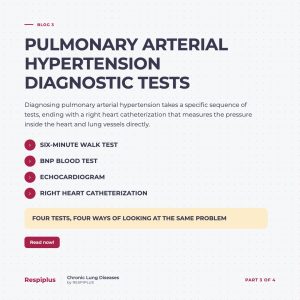
The six-minute walk test, the BNP blood test, the echocardiogram and the right heart catheterization. What each test measures and what to expect at a PH centre.