

Biologics for COPD: A Practical Guide for Clinicians
Dr. Stephanie Christenson discusses COPD biologics, eosinophil biomarkers and trial evidence in Season 8 of The eXpand Podcast.
The diagnosis came and went. The appointments ended. The new term settled in. Alpha-1 antitrypsin deficiency. Alpha-1. What stayed with Marie was not the name of the condition. It was the question her respirologist asked after the basics were covered.
“Has anyone else in your family ever had their Alpha-1 level checked with a blood test?”
Marie had not thought that far ahead. She was still focused on her own breathing. But suddenly the picture widened. Her brother, who smoked and shrugged off his cough. Her daughter in her twenties ran long distances and never got sick. Her father, who died young with what everyone called bad lungs.
Alpha-1, she learned, often shows up in more than one person in a family. Alpha-1 does not appear out of nowhere, it is inherited. What is not predictable is who will be affected, or when.
People in the same family can share the same risk and have very different experiences. One person may develop lung disease early. Another may feel well for decades. Some may have liver involvement and others may never show signs at all. Feeling well does not rule out low Alpha-1 levels. Symptoms often appear late, after damage has already occurred. This is why Alpha-1 can remain unrecognized in families for generations, labeled as smoking-related COPD, asthma, chronic bronchitis, or simply bad luck.
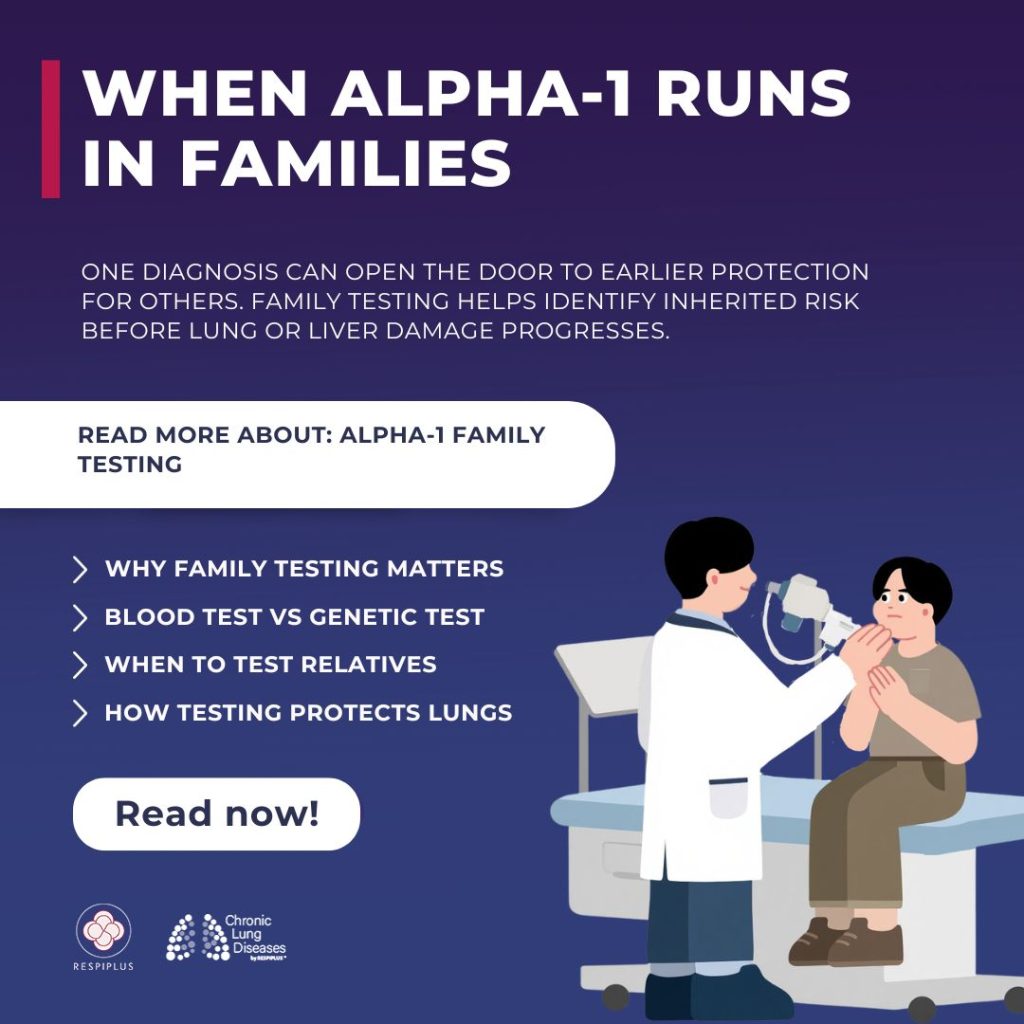
Family testing is not about assigning a diagnosis to everyone. It is about identifying risk early enough to act on it. When low Alpha-1 levels are detected before symptoms appear, people can avoid exposures that accelerate lung damage, especially smoking and certain occupational irritants. Lung function can be monitored over time rather than discovered after a decline. Liver health can be monitored while it still appears normal.
Even when no treatment is needed, early knowledge changes decisions. It replaces surprise with planning. It shifts care from reaction to prevention. Waiting for symptoms often means waiting until options are narrower.
The hardest part is not the test, it is the conversation. Many people hesitate to speak to family members. Not because they do not care, but because the implications feel heavy. Some worry about blame, others worry about creating anxiety. Many worry about what testing might mean for insurance or employment, or how results are ordered, labeled, and recorded in medical files. Waiting for symptoms often means waiting until options are narrower.
These concerns are not abstract. In Canada, people are increasingly aware that how and where medical information is documented matters. That is why the type of test ordered, the words used on requisitions and charts, and the timing of decisions all matter. Family conversations are rarely straightforward. Some relatives want testing immediately, others delay testing and some avoid it altogether. This is not uncommon, and Alpha-1 awareness often unfolds unevenly within families.
Sharing information is not about causing alarm. It is about giving others the option to decide with more information than you had.
For most people, family testing begins with a simple blood test that measures the level of Alpha-1 protein in the blood. This is a screening blood test, not a genetic test. It answers a basic question; is the level low or not.
If levels are normal, no further testing may be needed. If levels are low, additional steps may be discussed. In some cases, this can include genetic testing. That is a separate decision, with different documentation and implications.
Testing pathways and coverage can differ by province and by pathway. Who orders the test, how results are recorded, and what follow-up looks like are not the same everywhere. This is why these conversations are best guided by a healthcare provider who understands Alpha-1 and can explain options before testing moves forward. There is no single pathway that fits every family. What matters is that people understand the steps, not just the outcome.

Clinicians should not wait for patients to raise family testing on their own. Many will not, especially early after diagnosis. Family testing should be introduced as preventive care, not as genetic labeling or risk assignment. Clear, careful language matters. So does reassurance that initial screening is a routine blood test, not an automatic genetic declaration.
In Alpha-1 and in COPD of unclear cause, clinicians are often the first and only point of contact where this connection can be made. A brief conversation can determine whether a family remains unaware for years or begins to understand what has shaped their respiratory health.
Referral to respirology or genetics may be appropriate later. The first step is simply opening the door.
Marie eventually spoke to her brother. He resisted at first. He felt fine. He did not want more testing. Months passed. When he did have his Alpha-1 level checked, it was low. He quit smoking soon after. Her daughter also had her Alpha-1 level checked. Her result was normal and the relief was quiet but meaningful.
Low Alpha-1 levels run in families, whether they are recognized or not. Awareness does the same. The difference is that awareness creates choice. One diagnosis can protect siblings, children, parents, and future generations. Not through urgency or fear, but through earlier knowledge and better timing. Alpha-1 does not stop with one person. Neither should the opportunity to prevent harm.
Alpha-1 is an inherited condition where the body has too little functional alpha-1 antitrypsin, a protective protein made mainly in the liver. This protein helps protect lung tissue from inflammation-related damage. When levels are low, lung damage can build slowly over years and cause COPD. Some people also develop liver problems because abnormal protein can build up in the liver.
Alpha-1 antitrypsin acts like a protective shield for the lungs. During infections, smoke exposure, or irritation, inflammation enzymes can damage healthy lung tissue. Alpha-1 helps keep that damage in check. Without enough functional protein, the lungs are more vulnerable to cumulative injury, which can lead to early emphysema or COPD-like changes. In some forms of Alpha-1, protein can also stress the liver.
Alpha-1 is one of the most common inherited conditions linked to COPD, but it is still underdiagnosed. It is missed because symptoms overlap with asthma and COPD, and smoking history can distract from genetic causes. Many people are diagnosed only after years of symptoms or repeated exacerbations. A simple blood serum level test can diagnose Alpha-1 earlier and change the care plan.
Yes. Smoking does not cause Alpha-1, but it can accelerate lung damage in people who have it, even with a relatively small smoking history. Some people with Alpha-1 have few or no symptoms for years, especially if they avoid smoking and reduce exposures. That is why family testing and early detection can matter: it supports prevention before major lung function is lost.
No. Alpha-1 can affect the liver because abnormal alpha-1 protein may build up in liver cells instead of being released into the bloodstream. Some people develop elevated liver enzymes, fibrosis, cirrhosis, or other liver complications. Not everyone with Alpha-1 will have liver disease, and severity varies by genetic type and other factors. Clinicians may monitor liver health as part of overall care.
Start with the simplest goal: do not miss a genetic contributor to lung damage. Alpha-1 testing is usually a serum blood level first, followed by confirmatory testing if low. Key context includes age at diagnosis, smoking or exposure history, rate of progression, and family history of lung or liver disease. These details affect how strongly results change the plan.
Many professional associations, such as the Canadian Thoracic Society, encourage testing in all people with COPD because the clinical “look” can be misleading. It is especially important in early onset COPD (often under 45 to 50), never-smokers, disproportionate emphysema, frequent exacerbations, or faster-than-expected decline. Testing once can prevent years of treating symptoms without addressing the driver.
Usually both, in sequence. The first step is commonly a serum alpha-1 antitrypsin level, a standard blood test. If the level is low (or suspicious), confirmatory testing may include phenotype or genotype testing, which clarifies the specific inherited variants. The practical point: the blood test is a simple screen, genetics helps confirm and guide family discussions.
This depends on local pathways and the severity of symptoms, but the sequence above keeps care organized and timely.
A big one is assuming smoking history rules it out. Another is skipping testing because the patient is “too old” or “does not look genetic.” Alpha-1 can present across a wide range, and environmental exposures can accelerate decline. A third mistake is stopping after a single borderline result without confirmatory testing when clinical suspicion is high.
Often, yes, but the approach should be careful and consent-based. Because Alpha-1 is inherited, first-degree relatives may want testing to understand risk and make earlier health choices. What it depends on: family planning concerns, privacy, insurance or employment worries, and emotional readiness. The best conversations are clear, non-alarmist, and centered on choice.
Not usually. A primary care clinician can often order the initial serum test as part of a COPD workup. Specialist involvement becomes most useful when levels are low, confirmatory testing is needed, symptoms are progressing, or advanced management decisions are on the table. The fastest route is often: screen in primary care, confirm and plan with respirology.
Jean Bourbeau, MD, MSc, FRCPC
Angela Diano, Executive Director, AlphaNet Canada
Katrina Metz, RT
Maria Sedeno, BEng, MM, GCSRT (Harvard)
RESPIPLUS™ received support from Takeda to develop this series specifically tailored to Alpha-1 antitrypsin deficiency (AATD).
Dr. Stephanie Christenson discusses COPD biologics, eosinophil biomarkers and trial evidence in Season 8 of The eXpand Podcast.
Explore how biologic therapies are transforming COPD care. Dr. MeiLan Han breaks down biomarkers, clinical trials, and patient selection in Season 8 of the eXpand Podcast.
Practical strategies to prevent respiratory infections in Indigenous and remote communities, including early intervention and community engagement.