

NATIONAL Report · Free
COPD and the single inhaler question
Canadian clinicians already believe in single inhaler triple therapy. A national investigation of 219 healthcare professionals and 292 people living with COPD shows why it still isn’t being prescribed to everyone who needs it.
RESPIPLUS national investigation · October 2026 · 32 pages · PDF
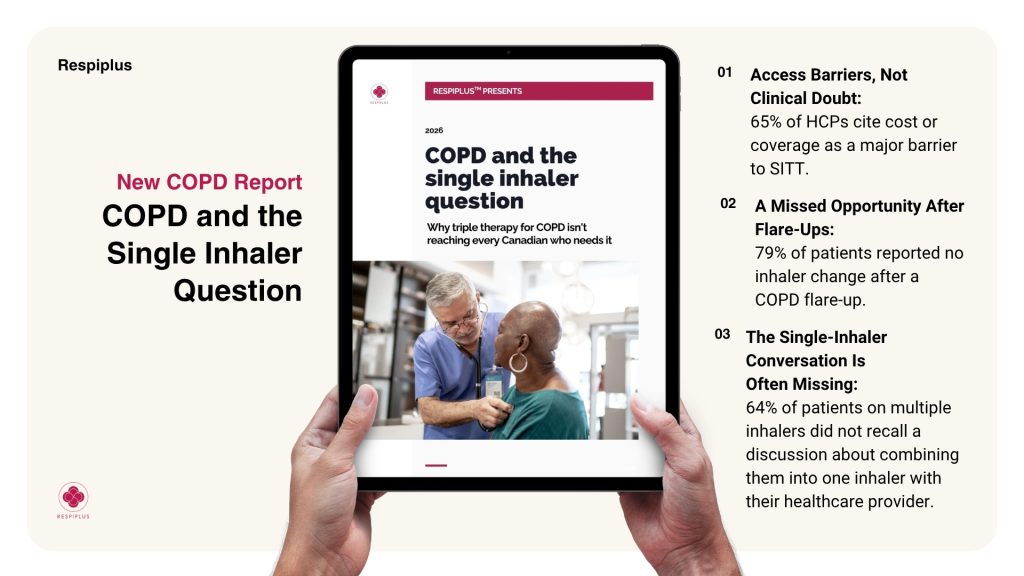
of patients seen by a clinician or admitted to hospital for a flare-up had no change to their
inhalers
The barrier isn't clinical doubt
Current Canadian guidelines recommend triple therapy for people with COPD at high risk of flare-ups, and in July 2026 Canada’s Drug Agency updated its national reimbursement recommendations to match. 87% of the healthcare professionals surveyed say single inhaler triple therapy (SITT) is always or
often their first-line choice for these patients.
So the question this investigation set out to answer was not whether clinicians are convinced. It was what happens between that conviction and the patient’s prescription.
The answer sits in three places: coverage rules, administrative paperwork, and the moments of care where a medication review should happen and often does not.
Seven findings from the field
or below.
A call to action, by role
Behind the investigation
This is a RESPIPLUS initiative. We gratefully acknowledge the involvement of representatives from the Canadian Thoracic Society, the Family Physician Airways Group of Canada, and COPD Canada. Their participation does not imply organizational endorsement of the findings or
recommendations.
Two survey instruments were fielded across Canada in the spring of 2026, in English and French, and reviewed before fielding by a Scientific and Patient Committee:
- Dr. Jean Bourbeau, MD, MSc, FRCPC, FCAHS
Respirologist and Professor of Medicine, McGill University Health Centre; Past President, Canadian Thoracic Society - Dr. Alan Kaplan, MD, CCFP(EM), FCFP, CPC(HC)
Family Physician; Chairperson, Family Physician Airways Group of Canada - Dr. Mohit Bhutani, MD, FRCPC
Respirologist and Professor of Medicine, University of Alberta;
Past President, Canadian Thoracic Society; Co-Chair, CTS COPD Clinical Assembly - Michael Boivin, BSc.Phm, RPh, CDE, CTH
Clinical Pharmacist Consultant; President, CommPharm Consulting Inc. - Henry Roberts
Patient representative, Executive Committee, COPD Canada
RESPIPLUS team
- Maria Sedeno, MM, BEng — Executive Director
- Emily Horvat, BSc — Senior Project Director
- Katrina Metz, RRT — Consultant
An initiative of RESPIPLUS, in collaboration with


Made possible through sponsorship from

Get the full report
Download the report now and see what 511 healthcare professionals and patients across Canada told us: the full data, the methodology, and every recommendation.
Frequently asked questions
Triple therapy combines three medication classes for people with COPD who keep having symptoms or flare-ups despite simpler treatment: an inhaled corticosteroid, a long-acting beta-agonist, and a long-acting muscarinic antagonist. Single inhaler triple therapy (SITT) delivers all three from one device. Multiple inhaler triple therapy (MITT) splits the same three classes across two or more devices.
219 healthcare professionals and 292 people living with COPD, across Canada, in the spring of 2026. Both surveys were offered in English and French. Respiratory therapists made up 52% of the healthcare professional sample.
Yes. It downloads without registration, a login or a paywall. You can leave your email if you would rather receive it in your inbox, but it is not required.
The investigation and this report were made possible by a sponsorship from Methapharm. The sponsor had no role in the development, content, or review of the report.
This report is for informational purposes only. It is not a clinical guideline and should not be used to influence patient treatment plans. Its content reflects the input of the members of the Scientific and Patient Committee and does not provide or supersede medical or professional advice — for any question, consult a qualified healthcare professional. Reliance on any information in this report is at your own risk. RESPIPLUS assumes no liability for its accuracy, completeness or timeliness.
This RESPIPLUS national investigation into single inhaler triple therapy in COPD, and the creation of this report, was made possible by a sponsorship from Methapharm. The sponsor did not have any role in the development, content, or review of this report.
Copyright © 2026 RESPIPLUS. All rights reserved.