Living Well with Pulmonary Fibrosis, by RESPIPLUS

Living Well with Pulmonary Fibrosis

An education program for people living with pulmonary fibrosis and the people who support them. Modules, guides and practical tools to understand the disease and manage its impact on daily life.

Developed by Julie Morisset, MD · Diane Nault, RN, MSc · Alexandre Savard, RN, BScN · Maria Sedeno, BEng, MM  ·  Medically reviewed by Katrina Metz, RT  ·  Last updated October 13, 2026

What is pulmonary fibrosis?

Pulmonary fibrosis is scarring of the tissue inside the lungs. In a healthy lung, the walls of the air sacs are thin and flexible, which is what lets oxygen pass easily into the blood with each breath. When those walls become scarred, they thicken and stiffen. The lungs cannot expand as fully, and oxygen does not cross into the blood as easily. That is why the first thing most people notice is breathlessness, at first only climbing stairs or walking uphill and later during ordinary activity, often alongside a dry cough and fatigue.
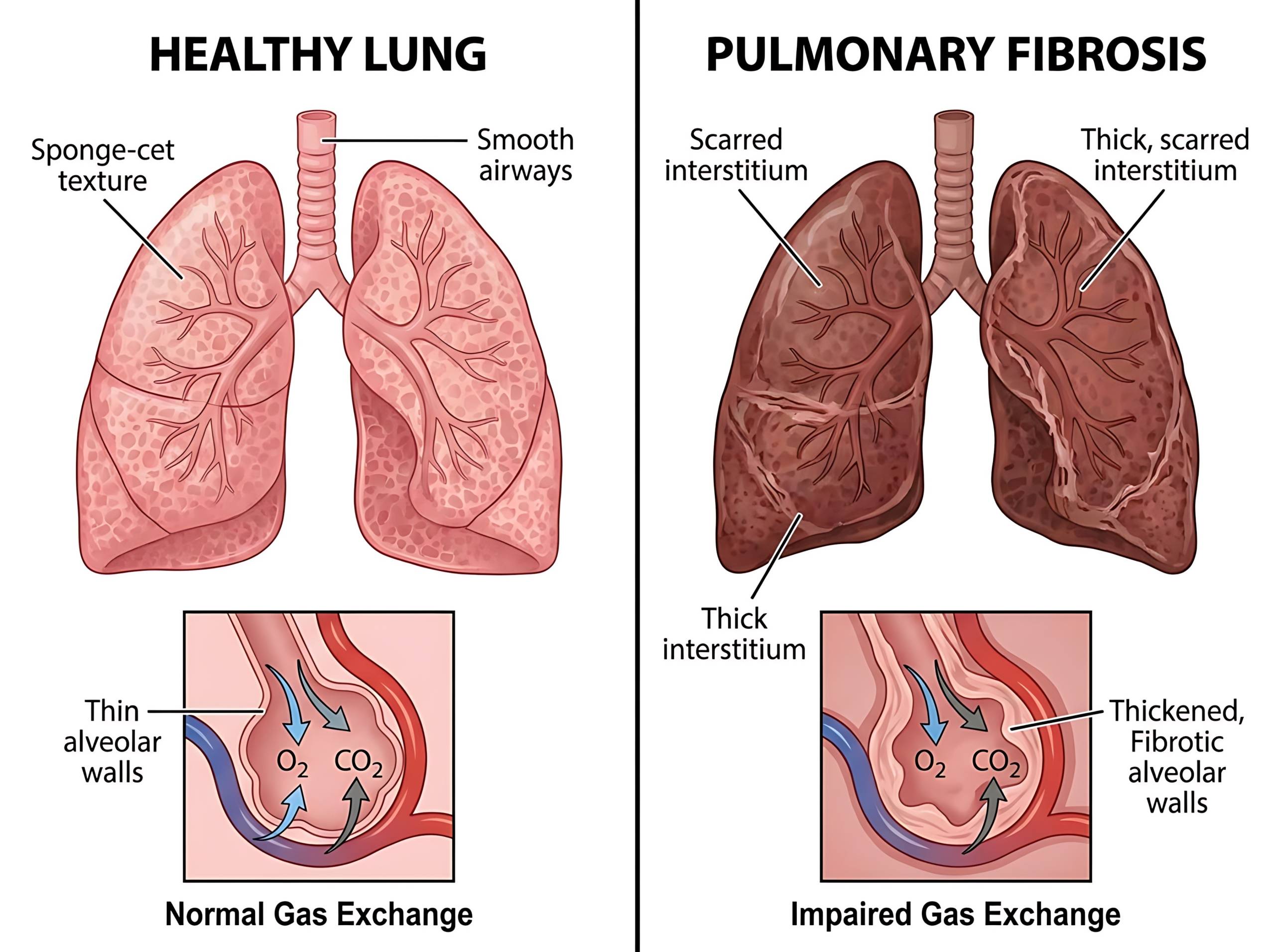
Side-by-side comparison of a healthy lung and a lung with pulmonary fibrosis. The healthy lung has smooth airways and thin alveolar walls allowing normal oxygen and carbon dioxide exchange; the fibrotic lung has a thickened, scarred interstitium and thickened alveolar walls, impairing gas exchange.
In a healthy lung the alveolar walls are thin, so oxygen crosses easily into the blood. In pulmonary fibrosis those walls become thickened and scarred, and gas exchange is impaired.

Pulmonary fibrosis is one of a larger group of conditions known as interstitial lung disease, and it is not a single illness. Some forms have an identifiable cause, such as an inhaled substance in hypersensitivity pneumonitis, or an underlying autoimmune condition in connective-tissue disease related pulmonary fibrosis. Others, including idiopathic pulmonary fibrosis (IPF) and idiopathic non-specific interstitial pneumonia (NSIP), have no identified cause. Some cases cannot be assigned to a category at all and are described as unclassifiable.

Because the types behave differently and are treated differently, the diagnosis usually takes more than one test. It typically combines your history and exposures, breathing tests, a high-resolution CT scan, blood work, and sometimes a lung biopsy, usually reviewed by a team that includes a respirologist, a radiologist and a pathologist together.

The scarring that has already formed does not go away. But pulmonary fibrosis is not something that only happens to you while you wait: treatment can slow some forms of the disease, and the things you do between appointments, such as staying active, avoiding what irritates your lungs, keeping vaccinations current, and acting early when symptoms change, have a real effect on how you feel and on how often you end up in hospital. That is what this program is for.

For general information about the disease, including symptoms and causes, diagnosis, management and treatment, see our pulmonary fibrosis section.

What is the Living Well with Pulmonary Fibrosis program?

Self-management is not a substitute for your medical care. It is the part of your care that happens between appointments: noticing what your breathing is normally like, spotting the day it changes, avoiding the things that set it off, and knowing who to call before a bad week becomes a hospital admission.

Each module pairs a clinical explanation with space to write down your own symptoms, triggers and goals, so that what you end up with is specific to you rather than general advice. The modules were designed to be worked through with a resource person, usually a nurse, respiratory therapist or educator attached to your clinic, but they are written so that you can also use them on your own, or with a family member.

Take it from the top, or skip to the topics that matter most to you right now. Share it with the people close to you so they understand what you are going through.

The eight modules

The program is organized in modules that follow the path of living with pulmonary fibrosis. Every one is a complete guide on its own. Free registration is required to open the materials.
Cover of module 1 of Living Well with Pulmonary Fibrosis, Dealing with a Diagnosis of Pulmonary Fibrosis
Module 01

Dealing with a Diagnosis of Pulmonary Fibrosis

You have been told you have pulmonary fibrosis. What does that actually mean for your lungs?

  • How a normal lung works, and what scarring changes about it
  • Signs, symptoms, and why breathlessness feels the way it does
  • The types: IPF, NSIP, hypersensitivity pneumonitis, connective-tissue related, unclassifiable
  • How the diagnosis is made, and adjusting to it

Start here if you were diagnosed recently, or you are supporting someone who was.

Open Module 01 (PDF, 32 pages)
Cover of module 2 of Living Well with Pulmonary Fibrosis, Adopting and Maintaining a Healthy and Fulfilling Lifestyle
Module 02

Adopting and Maintaining a Healthy and Fulfilling Lifestyle

Can you still travel, eat normally and enjoy your life with pulmonary fibrosis?

  • Eating well when breathing takes more energy than it used to
  • Sleep and sexual life
  • Planning leisure activities, and what to arrange before a trip
  • Living in a smoke-free environment

Start here if you want to keep doing the things you enjoy and need the practical detail.

Open Module 02 (PDF, 40 pages)
Cover of module 3 of Living Well with Pulmonary Fibrosis, Treating Pulmonary Fibrosis
Module 03

Treating Pulmonary Fibrosis

What are these medications doing, and what happens if you miss them?

  • Anti-fibrotics in idiopathic pulmonary fibrosis
  • Immunosuppressants
  • Medications used to treat an exacerbation
  • Non-pharmacological treatment, and lung transplant

Start here if you have just been prescribed something new and want to understand it.

Open Module 03 (PDF, 36 pages)
Cover of module 4 of Living Well with Pulmonary Fibrosis, Managing the Impact of Pulmonary Fibrosis
Module 04

Managing the Impact of Pulmonary Fibrosis

Being short of breath makes you anxious, and being anxious makes you more short of breath. How do you break that?

  • Stress, anxiety, and the anxiety-breathlessness cycle
  • Relaxation techniques
  • Managing breathlessness in the moment
  • Saving your energy for what matters to you

Start here if breathlessness is starting to shrink what you are willing to do.

Open Module 04 (PDF, 28 pages)
Cover of module 5 of Living Well with Pulmonary Fibrosis, An Action Plan for When Your Symptoms Get Worse
Module 05

An Action Plan for When Your Symptoms Get Worse

Your breathing is worse than yesterday. Do you wait and see, call your clinic, or call an ambulance?

  • Recording what your symptoms are like on a normal day
  • The factors that trigger a worsening, and how to avoid them
  • The two signs that should prompt a call, and the 48-hour rule
  • When to call 911, plus a contact list you fill in and keep

Start here if you read only one module. This is the one to have before you need it.

Open Module 05 (PDF, 24 pages)
Cover of module 6 of Living Well with Pulmonary Fibrosis, Get Moving... Breathe Easy with Pulmonary Fibrosis
Module 06

Get Moving… Breathe Easy with Pulmonary Fibrosis

If moving makes you breathless, is exercise still safe, and how much is enough?

  • Why activity helps, even when it feels counterintuitive
  • Judging whether you are working at the right intensity
  • Which symptoms during activity are normal, and which are not
  • Maintaining your level, and building it up gradually

Start here if you have been moving less and are not sure how to start again safely.

Open Module 06 (PDF, 24 pages)
Cover of module 7 of Living Well with Pulmonary Fibrosis, Integrating Long-Term Oxygen Therapy Into Your Life
Module 07

Integrating Long-Term Oxygen Therapy Into Your Life

You have been prescribed oxygen. What actually changes about leaving the house?

  • Why oxygen is prescribed in pulmonary fibrosis, and how it helps
  • Using your equipment properly
  • Living with oxygen day to day: going out, travelling, sleeping
  • Handling how it feels to be seen using it

Start here if oxygen has just been raised, or you have been putting off using it.

Open Module 07 (PDF, 40 pages)
Cover of module 8 of Living Well with Pulmonary Fibrosis, Pulmonary Fibrosis and End of Life
Module 08

Pulmonary Fibrosis and End of Life

These are decisions you can make yourself, or decisions that get made for you in an emergency.

  • What to expect as the disease advances
  • What resuscitation does and does not offer in advanced lung disease
  • Ventilators
  • Nearing the end of life

Read this whenever you want to. Many people read it long before it applies to them, and some never do.

Open Module 08 (PDF, 16 pages)
Also available

Living Well Smoke Free

A separate smoking cessation module, shared across the Living Well programs. Module 2 already covers living in a smoke-free environment; this one is for the person who wants to stop.

Open Living Well Smoke Free (PDF, 48 pages)

Choose your path

For patients and families

Resources for people living with pulmonary fibrosis and the people who care for them.

Resources for patients
For health professionals

Materials to use with your own patients, and the clinical background behind the program.

Resources for health professionals

Who developed this program

Living Well with Pulmonary Fibrosis was written by Julie Morisset, MD, Diane Nault, RN, MSc, Alexandre Savard, RN, BScN and Maria Sedeno, BEng, MM, in collaboration with Deborah Assayag, MD, Jean Bourbeau, MD, MSc, FRCP, Bruno-Pierre Dubé, MD, Patricia Côté, RN, M.A. (RQESR), Geneviève Tremblay and Dominique Massie (Association pulmonaire du Québec).

Participating institutions
  • The Research Institute of the McGill University Health Centre
  • University of California, San Francisco
  • Centre Hospitalier de l'Université de Montréal
  • RQESR, Réseau québécois d'éducation en santé respiratoire
  • APQ, Association pulmonaire du Québec
University of California, San Francisco The Research Institute of the McGill University Health Centre Centre Hospitalier de l'Universite de Montreal RQESR, Reseau quebecois d'education en sante respiratoire Association pulmonaire du Quebec
RESPIPLUS
A note from Respiplus

At Respiplus, we understand that living with pulmonary fibrosis can be challenging, but we want you to know that you are not alone on this journey. Our mission is to provide you with the knowledge and tools you need to take an active role in your care. This educational program was created with you in mind, to empower you to feel more in control of your life with PF. We are here to help you live well.

Other Living Well programs

Living Well with COPD

The self-management program for chronic obstructive pulmonary disease.

Go to the COPD program

Living Well with Severe Asthma

The self-management program for severe asthma.

Go to the asthma program

Frequently Asked Questions

Is there a free self-management program for pulmonary fibrosis?

Yes. Living Well with Pulmonary Fibrosis is a free education program of eight modules developed by RESPIPLUS with respirologists, nurses and patients. It covers the diagnosis, treatment, daily life, exercise, oxygen therapy, flare-ups and end-of-life care. There is no cost, and you create a free account to open the materials.

What is pulmonary fibrosis?

Pulmonary fibrosis is scarring of the tissue inside the lungs. The scarring makes the walls of the air sacs thicker and stiffer, so the lungs cannot expand fully and oxygen does not pass into the blood as easily. The usual first symptoms are breathlessness on exertion, a dry cough and fatigue. It is one of a group of conditions called interstitial lung disease, and it has several types, including idiopathic pulmonary fibrosis.

What does the Living Well with Pulmonary Fibrosis program include?

Eight modules: dealing with a diagnosis; adopting and maintaining a healthy and fulfilling lifestyle; treating pulmonary fibrosis; managing the impact of the disease; an action plan for when symptoms get worse; physical activity; integrating long-term oxygen therapy; and pulmonary fibrosis and end of life. A separate smoking cessation module, Living Well Smoke Free, is also available. Each module combines clinical explanation with space to record your own symptoms, triggers and goals.

Do I need an account to open the modules?

Yes. Opening the modules requires a free account, which takes a minute to create. There is no cost and no payment information is requested.

Is the program available in French?

Yes. The whole program is available in French as well as English. You can find the French modules on the French version of this page.

What should I do when my pulmonary fibrosis symptoms get worse?

Two changes should prompt you to act: more shortness of breath than usual, and sputum that turns yellow or green. Contact your doctor or resource person rather than waiting to see whether it settles, and do not wait more than 48 hours after symptoms start to worsen. If you are extremely short of breath, agitated, confused or drowsy, or have chest pain, call 911. Module 5 covers this in full.

How do you integrate long-term oxygen therapy into daily life?

Module 7 covers why oxygen is prescribed in pulmonary fibrosis, how to use the equipment correctly, and the practical side of living with it: going out, travelling, sleeping, managing tubing at home, and dealing with how it feels to use oxygen in public.

Who developed the program, and what is it based on?

It was developed by RESPIPLUS, written by Julie Morisset, MD, Diane Nault, RN, MSc, Alexandre Savard, RN, BScN and Maria Sedeno, BEng, MM, with collaborators including Jean Bourbeau, MD, MSc, FRCP. Participating institutions include the Research Institute of the McGill University Health Centre, the University of California, San Francisco and the Centre Hospitalier de l'Université de Montréal. The program was updated after a pilot study with healthcare professionals and patients at UCSF and CHUM.

Can health professionals use these modules with their own patients?

Yes. The modules were designed to be worked through by a patient together with a resource person, typically a nurse, respiratory therapist or educator, and each one ends with a goal-setting section intended to be completed and reviewed at follow-up visits.

Related resources

More on living well with pulmonary fibrosis.

Pulmonary fibrosis and exercise: how to stay active safely
Article

Pulmonary Fibrosis and Exercise: How to Stay Active

Which symptoms during activity are normal, which mean stop, and how to break the cycle of moving less and getting more breathless.

Read the article
Nutrition and pulmonary fibrosis: eating well for better breathing
Article

Nutrition and Pulmonary Fibrosis: Eating Well for Better Breathing

What to eat, what to limit, and how to keep eating well when breathing already takes more energy than it used to.

Read the article
Podcast

The eXpand Podcast

Conversations with specialists on chronic lung disease, across every season of the series.

Listen to the podcast

Questions?

See our frequently asked questions or contact us.

This content is intended for education and does not replace clinical judgement or individualized medical advice. Speak with your healthcare team about your own situation.

Free download

Get the whole program

Create a free account to open all eight modules, in English or French. No cost, no payment details.

Create a free account

Already a member? Sign in