

COPD Clinical Tools for Healthcare Professionals
Your patient is on triple therapy and still exacerbating. What do you check before you escalate?
Five COPD clinical tools from Respiplus, built for the moments in COPD care where the next step is not obvious: confirming therapy is truly optimized, reading an eosinophil count in context, and knowing what a complete referral contains.
Developed for healthcare professionals in Canada. References the Canadian Thoracic Society 2023 guidance and the GOLD 2026 Report.
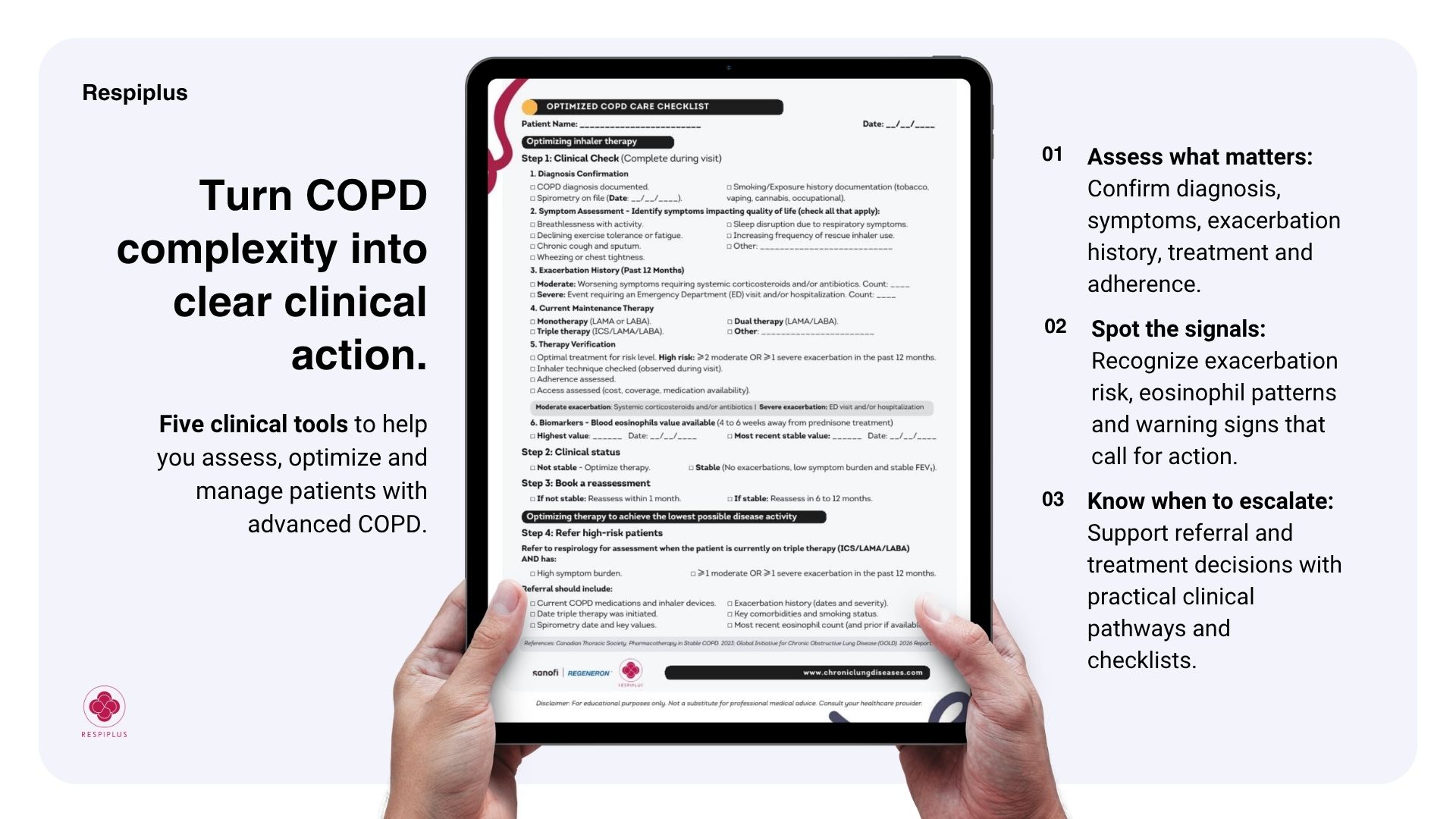
What are the Respiplus COPD clinical tools?
The Respiplus COPD clinical tools are five downloadable resources for healthcare professionals managing advanced COPD. Each one addresses a specific decision point, from confirming that inhaled therapy is optimized through to identifying a biologic candidate.
The five tools
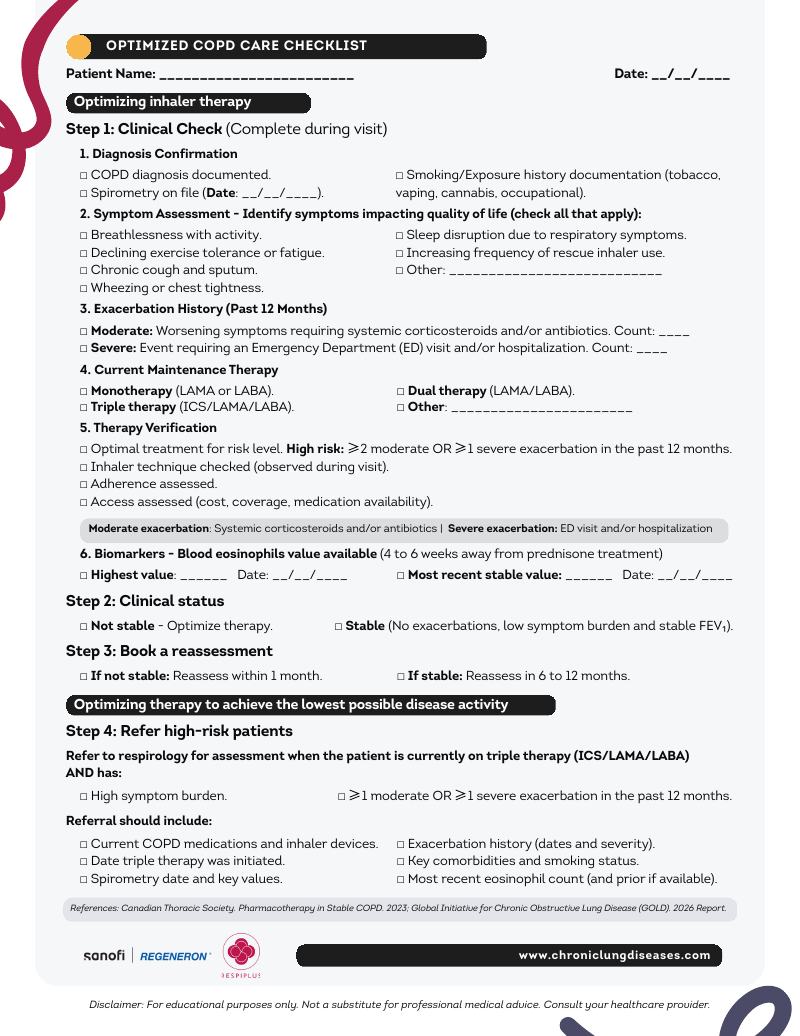
Optimized COPD Care Checklist
Your patient is on triple therapy and still exacerbating. Is the treatment failing, or is something upstream still fixable?
- Seven-point clinical check completed during the visit, not after it
- Diagnosis, symptoms, exacerbation history, current therapy and verification in one page
- Separates what is fixable, technique, adherence and access, from what is not
- Ends in a clinical status and a dated reassessment
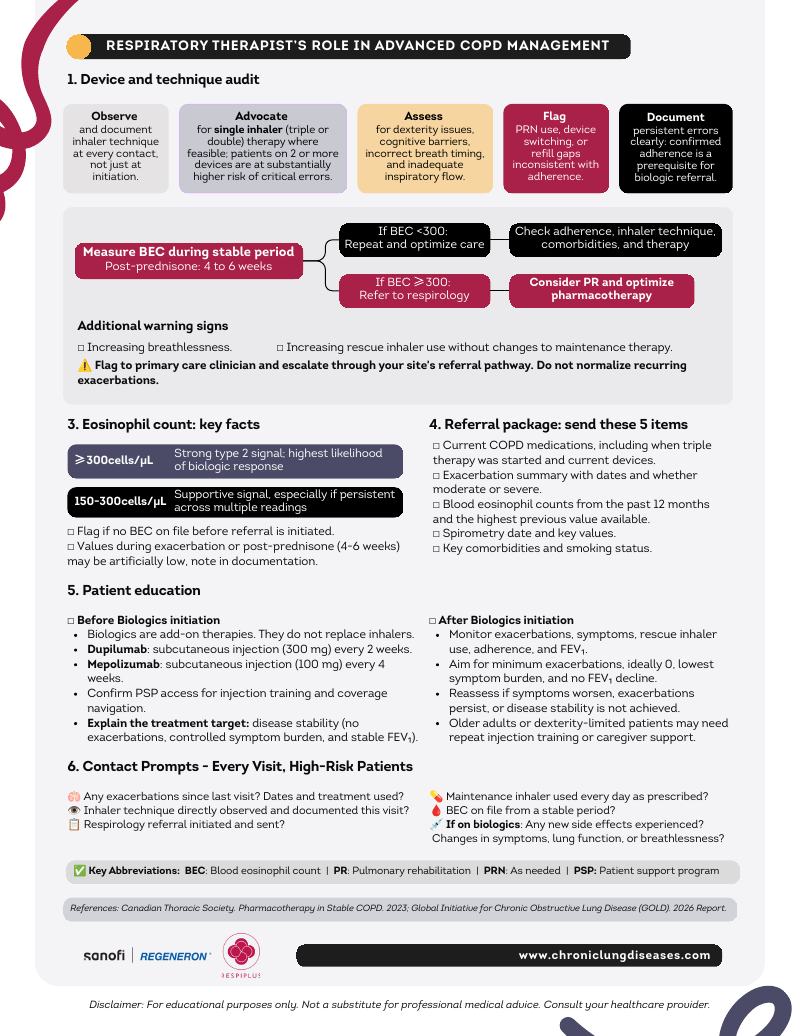
Respiratory Therapist’s Role in Advanced COPD Management
You have watched this patient use their device incorrectly at three consecutive visits. Where does that observation go?
- Device and technique audit structured for every contact, not only at initiation
- Escalation triggers, including persistent errors and rising rescue inhaler use
- Eosinophil measurement timing: during a stable period, four to six weeks post-prednisone
- The five items that make a referral package complete
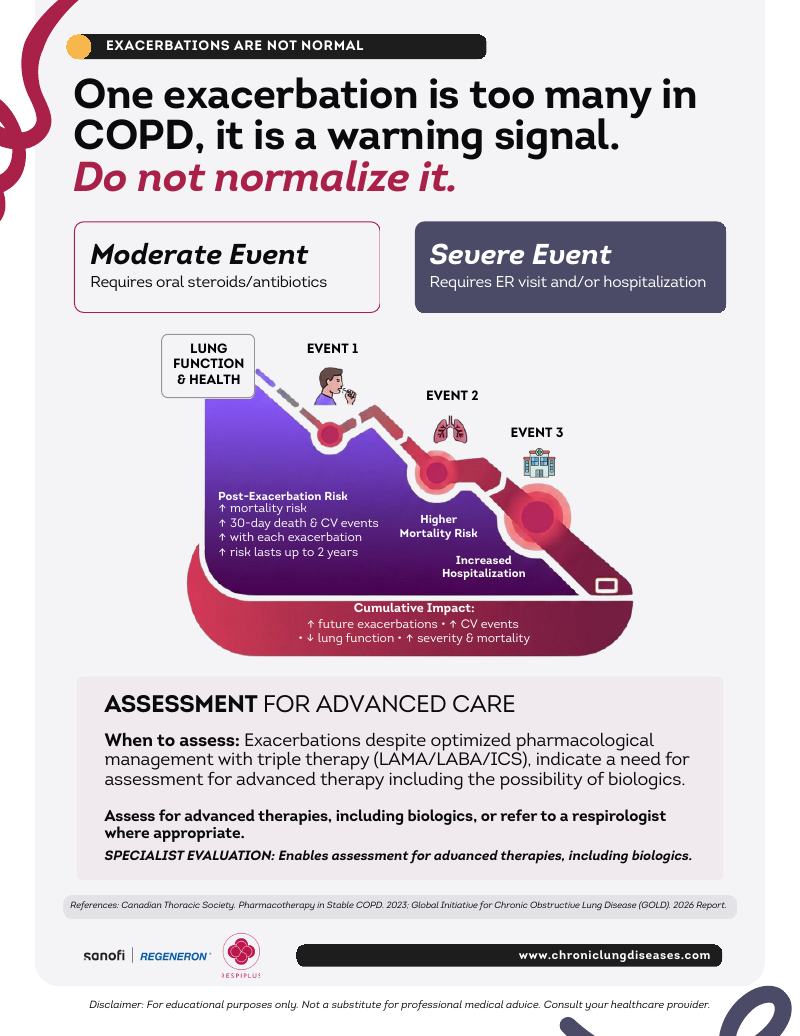
Exacerbations Are Not Normal
Your patient describes two flare-ups this year as a good year. Do they know what those events cost them?
- Moderate and severe exacerbations defined side by side
- Cumulative impact shown visually: lung function, hospitalization, mortality risk
- Post-exacerbation risk persists up to two years after the event
- Assessment for advanced care, including evaluation for biologics
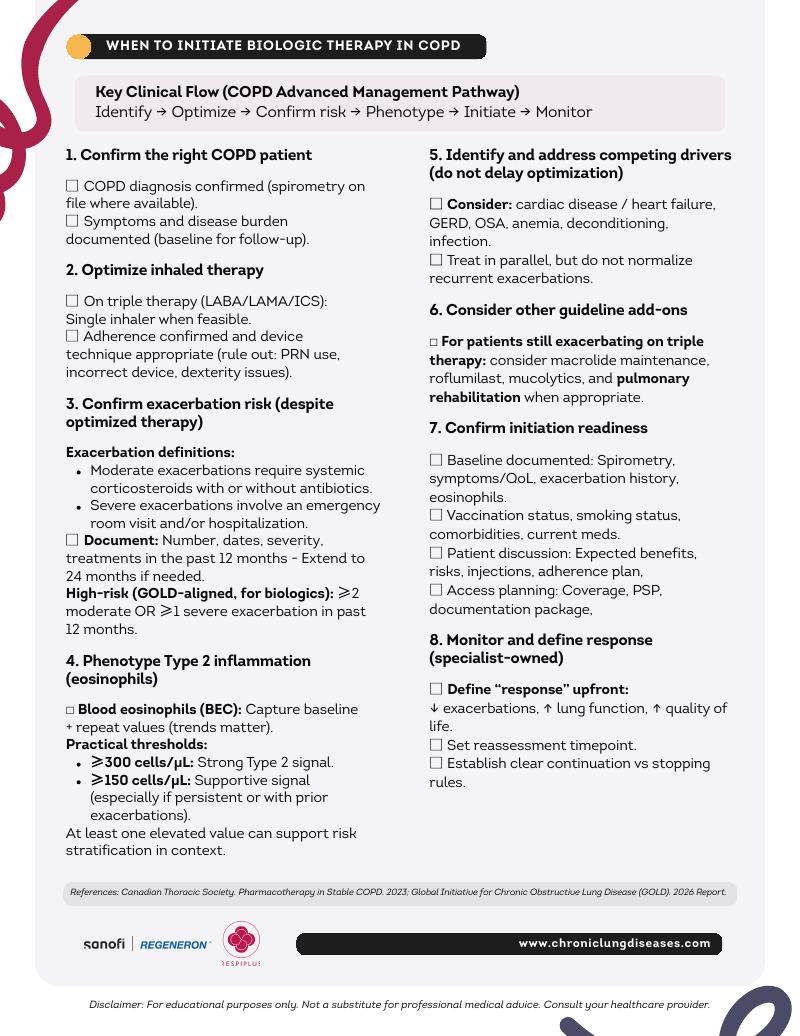
When to Initiate Biologic Therapy in COPD
You think this patient might be a biologic candidate. What has to be true before you refer?
- Seven-step pathway: identify, optimize, confirm risk, phenotype, initiate, monitor
- Competing drivers to address in parallel: cardiac disease, GERD, OSA, anemia, infection
- Guideline add-ons to consider first: macrolide maintenance, roflumilast, mucolytics, pulmonary rehabilitation
- Initiation readiness checklist covering baseline documentation and vaccination status
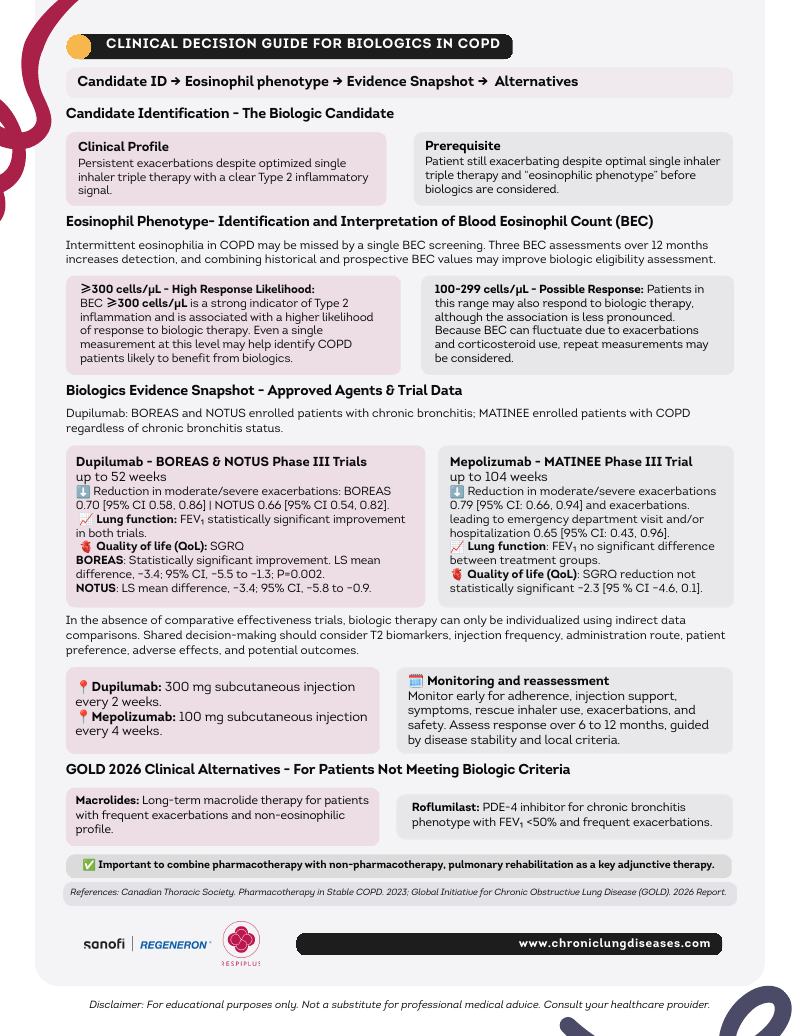
Clinical Decision Guide for Biologics in COPD
The eosinophil count came back at 240 cells/µL. Does that rule the patient out?
- Blood eosinophil count interpreted by band: 300 cells/µL and above, and 100 to 299 cells/µL
- Why a single measurement can miss intermittent eosinophilia, and how repeat testing helps
- Candidate profile and the prerequisite before biologics are considered
- Evidence snapshot of the approved agents and their trial data
When should a COPD patient be referred for biologic therapy?
Refer a COPD patient for assessment when the patient continues to exacerbate despite optimized single inhaler triple therapy. Optimized means confirmed adherence, verified inhaler technique and assessed access.
Refer to respirology when the patient is on triple therapy (ICS/LAMA/LABA) and has a high symptom burden, or one or more moderate exacerbations, or one or more severe exacerbations in the past twelve months.
Specialist evaluation enables assessment for advanced therapies, including biologics.
What blood eosinophil count indicates a biologic candidate in COPD?
A blood eosinophil count of 300 cells/µL or higher is a strong indicator of type 2 inflammation. It is associated with a higher likelihood of response to biologic therapy. Even a single measurement at this level may help identify candidates.
A count between 100 and 299 cells/µL indicates a possible response, although the association is less pronounced.
Eosinophil counts fluctuate. Intermittent eosinophilia may be missed by a single screening. Three assessments over twelve months increase detection. Measure during a stable period, four to six weeks after prednisone treatment.
What is the difference between a moderate and a severe COPD exacerbation?
A moderate exacerbation involves worsening symptoms requiring systemic corticosteroids, antibiotics, or both.
A severe exacerbation requires an emergency department visit, a hospitalization, or both.
One exacerbation is too many. Each event raises mortality risk, increases the likelihood of future exacerbations and accelerates lung function decline. The elevated risk lasts up to two years. Do not normalize recurring exacerbations.
What should a COPD referral package include?
Send these five items with a respirology referral:
- Current COPD medications, including when triple therapy started and current devices
- Exacerbation summary with dates and severity
- Spirometry date and key values
- Key comorbidities and smoking status
- Most recent eosinophil count, with prior values if available
How do you confirm inhaler therapy is optimized before escalating?
Confirm four things before you escalate. Verify that treatment matches risk level. Observe inhaler technique during the visit rather than asking about it. Assess adherence. Assess access, including cost, coverage and medication availability.
Patients on two or more devices face a substantially higher risk of critical errors. Advocate for single inhaler therapy where feasible.
Who are these tools for?
The tools are designed for healthcare professionals in Canada: family physicians, respirologists, respiratory therapists, nurse practitioners and pharmacists involved in COPD care. They are not patient education materials.
Patients and families looking for COPD self-management education can use the free Living Well with COPD program.
Are the tools free and what guidelines are they based on?
Yes. All five tools are free to download and free to use in practice.
The tools reference the Canadian Thoracic Society Pharmacotherapy in Stable COPD 2023 guidance and the Global Initiative for Chronic Obstructive Lung Disease 2026 Report. Respiplus developed them as an educational activity. They are not a substitute for professional medical judgment.
Download the COPD Clinical Tools
Complete the form and download all five tools now. Free, no commitment.
These tools reference the Canadian Thoracic Society, Pharmacotherapy in Stable COPD, 2023, and the Global Initiative for Chronic Obstructive Lung Disease, 2026 Report.
This educational activity was sponsored by Sanofi and Regeneron.
For educational purposes only. Not a substitute for professional medical advice. Intended for licensed healthcare professionals. © Respiplus 2026
COPD Clinical Tools
All five tools in one PDF. For healthcare professionals in Canada.
Download the tool set