

Lung Cancer: Education and Resources for Patients and Healthcare Professionals
Lung cancer is the leading cause of cancer-related death in Canada. In 2024, about 32,100 Canadians were expected to be diagnosed with lung cancer, and approximately 20,700 were expected to die from the disease. That is more deaths than from breast, prostate, and colorectal cancers combined.
The good news is that lung cancer treatment has changed significantly over the past decade. New therapies, better diagnostic tools, and earlier detection are improving survival rates for many patients. Understanding the disease is the first step toward better care.
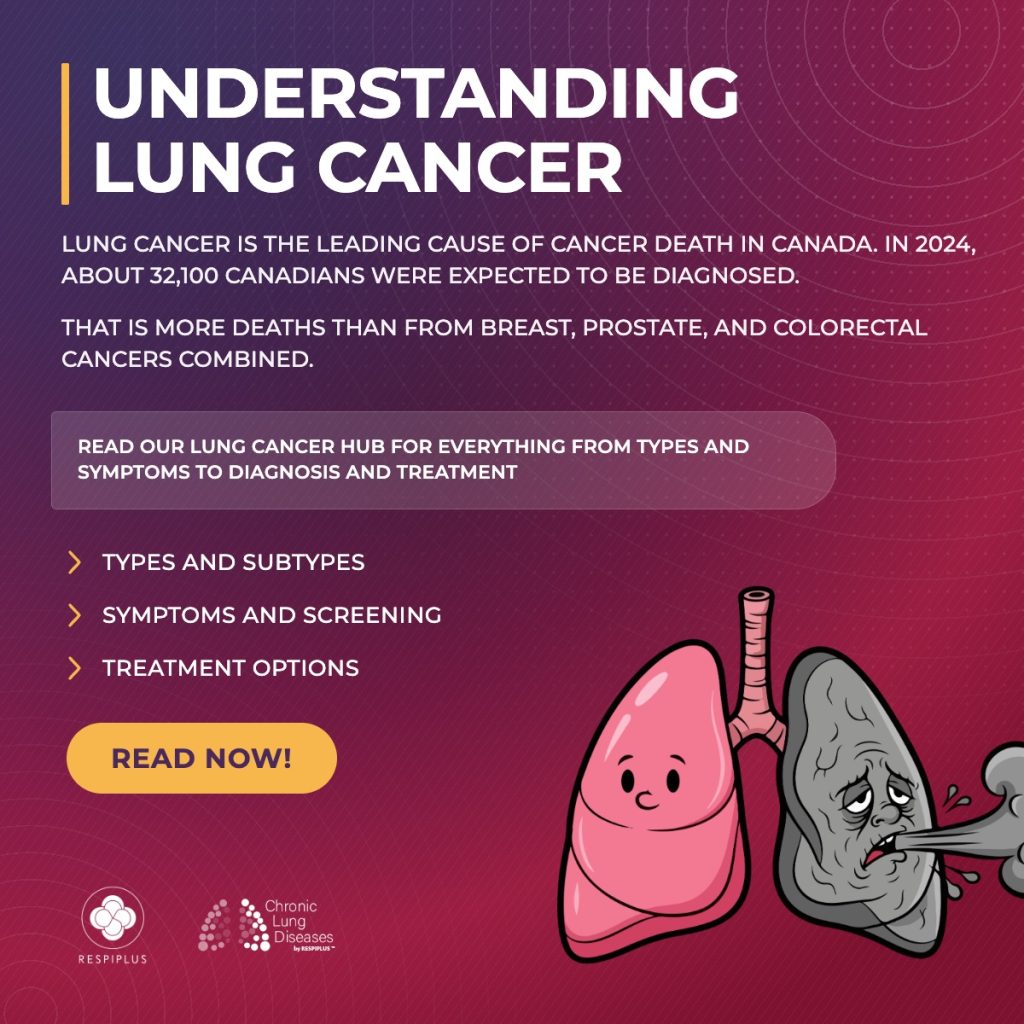
Table of Contents
What Is Lung Cancer?
Lung cancer begins when cells in the lungs grow out of control. Normally, cells in the body grow, divide, and die in an orderly way. When something goes wrong with this process, cells can keep growing and form a mass called a tumour.
Lung cancer that starts in the lungs is called primary lung cancer. This is different from secondary lung cancer, which is cancer that starts somewhere else in the body and spreads to the lungs. The lungs are divided into a total of 5 sections, called lobes, with three lobes on the right and two on the left. Cancer can develop in any one of these lobes.
Types of Lung Cancer
There are two main types of lung cancer. They behave differently and are treated differently.
Non-small cell lung cancer (NSCLC) is the most common type, making up about 80-85% of all lung cancer cases. Subtypes include adenocarcinoma, squamous cell carcinoma, and large cell carcinoma.
Small cell lung cancer (SCLC) makes up the remaining cases. It tends to grow and spread faster and is almost always linked to heavy smoking.
Knowing which type of lung cancer a person has is essential for choosing the right treatment. Some subtypes, such as ALK-positive NSCLC, respond to specific targeted drugs that can significantly improve outcomes.
Symptoms
Lung cancer often causes no symptoms in its early stages. Symptoms usually appear when the disease is more advanced, which is one reason why nearly half of all lung cancer cases in Canada are diagnosed at a late stage.
The most common symptoms include:
- A cough that does not go away or gets worse over time
- Coughing up blood, even a small amount
- Shortness of breath
- Chest pain when breathing or coughing
- Unexplained weight loss
- Persistent tiredness or lack of energy
- Hoarseness or changes in your voice
- Recurring chest infections
People with existing lung disease such as COPD may find that their symptoms are initially attributed to their known condition. If any new or worsening symptoms are noticed, a healthcare professional should be consulted.
Risk Factors
Smoking is the single biggest risk factor for lung cancer, responsible for about 72% of all cases in Canada. But lung cancer also develops in people who have never smoked.
Other risk factors include:
- Secondhand smoke
- COPD: people living with COPD have a significantly elevated risk of lung cancer, independent of their smoking history
- Radon gas: a naturally occurring gas that can build up in Canadian homes, especially in basements
- Occupational exposures: asbestos, arsenic, chromium, nickel, diesel exhaust, and silica
- Air pollution
- Family history of lung cancer
- Previous radiation therapy to the chest
- Age: most diagnoses occur in people over 65
Diagnosis
Diagnosing lung cancer usually involves imaging, followed by a biopsy to confirm the diagnosis and identify the type. Molecular testing is then done to find specific genetic changes that guide treatment decisions.
Lung cancer screening is now available in several Canadian provinces for people at high risk. If you are between 55 and 74 with a significant smoking history, ask your healthcare provider whether you qualify for a low-dose CT scan.
Treatment
Treatment depends on the type of lung cancer, how far it has spread, and the patient’s overall health. Main options include surgery, radiation therapy, chemotherapy, targeted therapy, and immunotherapy. Palliative care is an important part of treatment at any stage.
ALK-positive NSCLC is treated with ALK inhibitors: a class of targeted drugs that has transformed outcomes for this group. Lorlatinib, a third-generation ALK inhibitor, is one of the preferred options today.
Supported by Pfizer and produced in collaboration with Carma Bros.
Survival and Outlook
About 22-27% of people diagnosed with lung cancer in Canada are still alive five years later. When caught at stage one, the five-year survival rate rises to about 62%. Lung cancer death rates in Canada have been declining at about 3.8% per year since 2015.
Resources and Support
External resources
Related resources on this site
References
Show references
- Canadian Cancer Society. 5 Facts About Lung Cancer in Canada (2023). https://cancer.ca/en/about-us/stories/2023/5-facts-about-lung-cancer
- Statistics Canada. Lung Cancer is the Leading Cause of Cancer Death in Canada. https://www.statcan.gc.ca/o1/en/plus/238-lung-cancer-leading-cause-cancer-death-canada
- Deng L et al. Projected estimates of cancer in Canada in 2024. CMAJ 2024. https://pmc.ncbi.nlm.nih.gov/articles/PMC11090635/
- Canadian Cancer Society. Canadian Cancer Statistics 2023. https://cancer.ca/en/about-us/media-releases/2023/canadian-cancer-statistics-2023
- Statistics Canada. Five-year cancer survival by stage at diagnosis. https://www.statcan.gc.ca/o1/en/plus/2773-when-caught-first-stage-five-year-survival-exceeds-90-four-five-most-common-cancers
About this article
Written by Katrina Metz, RT, respiratory therapist and medical writer at RESPIPLUS. Medically reviewed by Dr. Geoffrey Liu, MD MPH, Senior Scientist at Princess Margaret Cancer Centre and a leading Canadian expert in ALK-positive NSCLC management.
About this project
This series was supported by Pfizer and developed independently by RESPIPLUS with the CARMA-BROS network. Scientific Committee: Dr. Geoffrey Liu (Princess Margaret), Maria Sedeno (RESPIPLUS), Emily Horvat (RESPIPLUS), Katrina Metz (RESPIPLUS), Christopher Deutschman (CARMA-BROS), Faisal Al Agha (CARMA-BROS). All materials are free and permanently hosted on chroniclungdiseases.com.
Published August 4, 2026. Last reviewed . For educational purposes only. Not a substitute for medical advice.