

Managing Lorlatinib in ALK+ NSCLC: A Free Video Education Series
A free video education series for Canadian healthcare professionals.
Twelve short, practical videos on managing Lorlatinib side effects in ALK-positive non-small cell lung cancer, structured around the PMMR framework.
Developed with Dr. Geoffrey Liu and the CARMA-BROS network at Princess Margaret Cancer Centre.
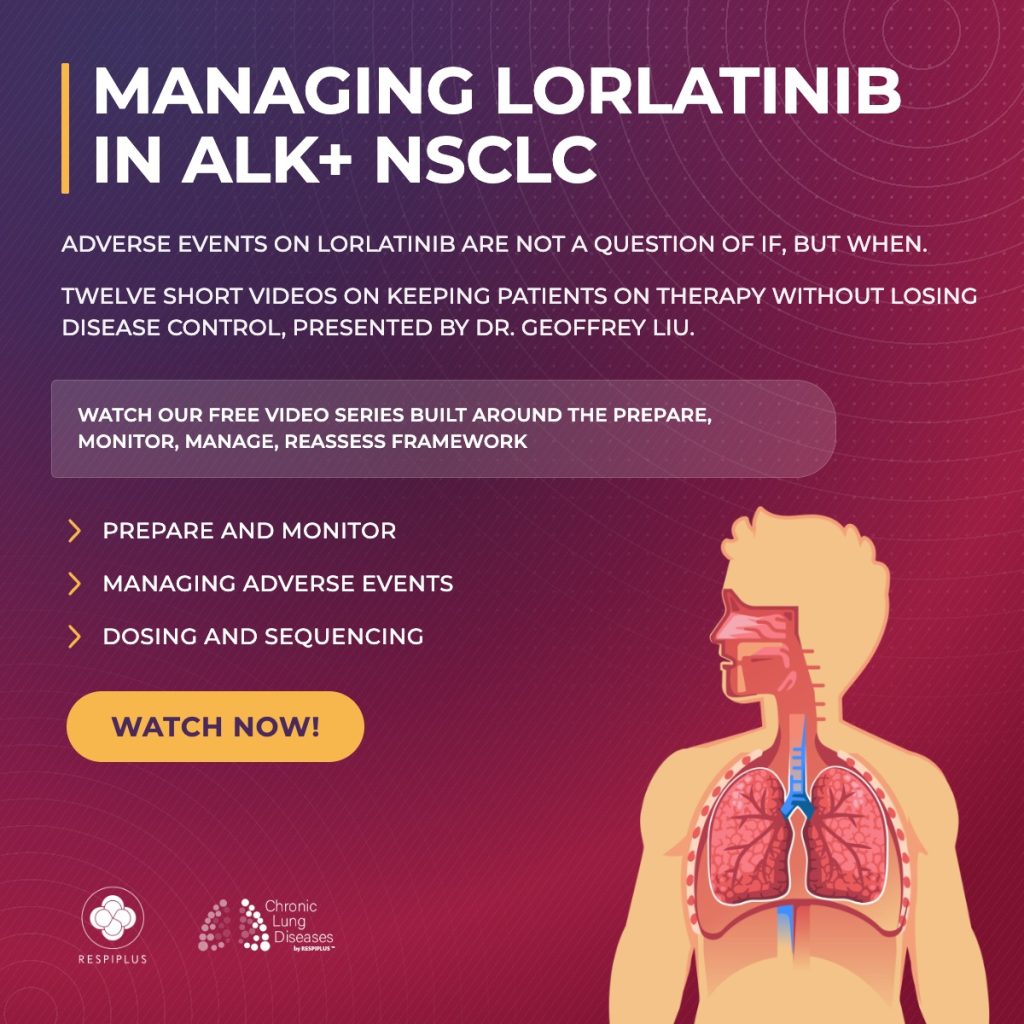
This free video education series was developed for Canadian healthcare professionals managing patients with ALK-positive non-small cell lung cancer on Lorlatinib therapy.
Each video is short, practical, and focuses on one clinical challenge. Accompanied by a downloadable clinical notecard summarizing the key messages for quick reference at the point of care.
This series was created by Respiplus in partnership with the CARMA-BROS network at the Princess Margaret Cancer Centre, under the clinical direction of Dr. Geoffrey Liu, MD MPH, Senior Scientist and leading Canadian expert in ALK+ NSCLC management.
Table of Contents
Who This Series Is For
- Community oncologists and respirologists managing ALK+ NSCLC patients
- Oncology nurses and nurse practitioners
- Pharmacists advising on drug interactions and dose decisions
- Physician assistants and clinic coordinators
The PMMR Framework
All videos are structured around the Prepare, Monitor, Manage, Reassess (PMMR) framework, a practical approach to managing Lorlatinib’s adverse effects developed by Dr. Liu and colleagues and published in Lung Cancer (2024).
- Prepare: What to tell the patient before starting Lorlatinib
- Monitor: What to look for, when, and in whom
- Manage: How to respond when a side effect appears
- Reassess: Is the intervention working? Are there new issues?
Video Series
Video 1: PMMR and the Foundations of ALK+ Patient Management
Introduction to the PMMR framework and its application to Lorlatinib therapy. Covers preparation before the first dose, monitoring schedules, and the overall structure of toxicity management.
Video 2: Weight Gain on Lorlatinib
How to identify early weight changes, understand their trajectory, and support patients with realistic lifestyle strategies.
Video 3: Peripheral Edema on Lorlatinib
Assessing peripheral edema, distinguishing benign from functionally limiting cases, and applying a stepwise management approach to maintain treatment continuity.
Video 4: Peripheral Neuropathy on Lorlatinib
Recognition of neuropathy patterns, functional impact, and practical interventions that allow patients to continue therapy safely.
Video 5: Cognitive and Mood Changes on Lorlatinib
Early signs of cognitive or mood alterations, rapid-interruption strategies, and safe re-initiation at modified doses.
Video 6: Brain Metastasis in ALK+ Disease
Why brain metastases shape treatment decisions, how ALK TKIs differ in CNS control, and what community oncologists should monitor.
Video 7: Hyperlipidemia and Metabolic Effects on Lorlatinib
Monitoring schedules, preferred lipid-lowering strategies, and realistic management plans that support long-term tolerability.
Video 8: Dosing and Dose Modification Strategies
How to start, interrupt, reduce, and maintain dosing while preserving efficacy, with practical real-world examples.
Video 9: Sequencing After Progression in ALK+ Disease
How to interpret systemic versus CNS progression and apply logical sequencing decisions in collaboration with tertiary centres.
Video 10: Clinical Tools for Monitoring and Follow-Up
Practical tools including AE checklists, lipid monitoring strategies, cognitive screens, and symptom tracking that support structured follow-up.
Video 11: When to Refer to a Specialist
Clear thresholds for involving neurology, psychiatry, cardiology, endocrinology, radiation oncology, or specialized oncology teams.
Video 12: Case-Based AE and Dosing Decisions
Real-world adverse events and dosing decisions, highlighting clinical reasoning, patient communication, and coordination of care.
About This Project
This series was supported by an educational grant from Pfizer and developed independently by Respiplus with the CARMA-BROS network.
Scientific Committee: Dr. Geoffrey Liu (Princess Margaret), Maria Sedeno (Respiplus), Emily Horvat (Respiplus), Katrina Metz (Respiplus), Christopher Deutschman (CARMA-BROS), Faisal Al Agha (CARMA-BROS).
All materials are free and permanently hosted on chroniclungdiseases.com.
Related Resources
About this article
Written by Katrina Metz, RT, respiratory therapist and medical writer at RESPIPLUS. Medically reviewed by Dr. Geoffrey Liu, MD MPH, Senior Scientist at Princess Margaret Cancer Centre and a leading Canadian expert in ALK-positive NSCLC management.
About this project
This series was supported by Pfizer and developed independently by RESPIPLUS with the CARMA-BROS network. Scientific Committee: Dr. Geoffrey Liu (Princess Margaret), Maria Sedeno (RESPIPLUS), Emily Horvat (RESPIPLUS), Katrina Metz (RESPIPLUS), Christopher Deutschman (CARMA-BROS), Faisal Al Agha (CARMA-BROS). All materials are free and permanently hosted on chroniclungdiseases.com.
Published August 4, 2026. Last reviewed . For educational purposes only. Not a substitute for medical advice.