

Lung Cancer and COPD: Understanding the Connection
COPD is an independent risk factor for lung cancer.
If you have COPD, your risk is significantly higher than the general population, even after accounting for smoking history and even in people who have never smoked.
This guide covers how much higher the risk is, why it happens, and what to watch for.
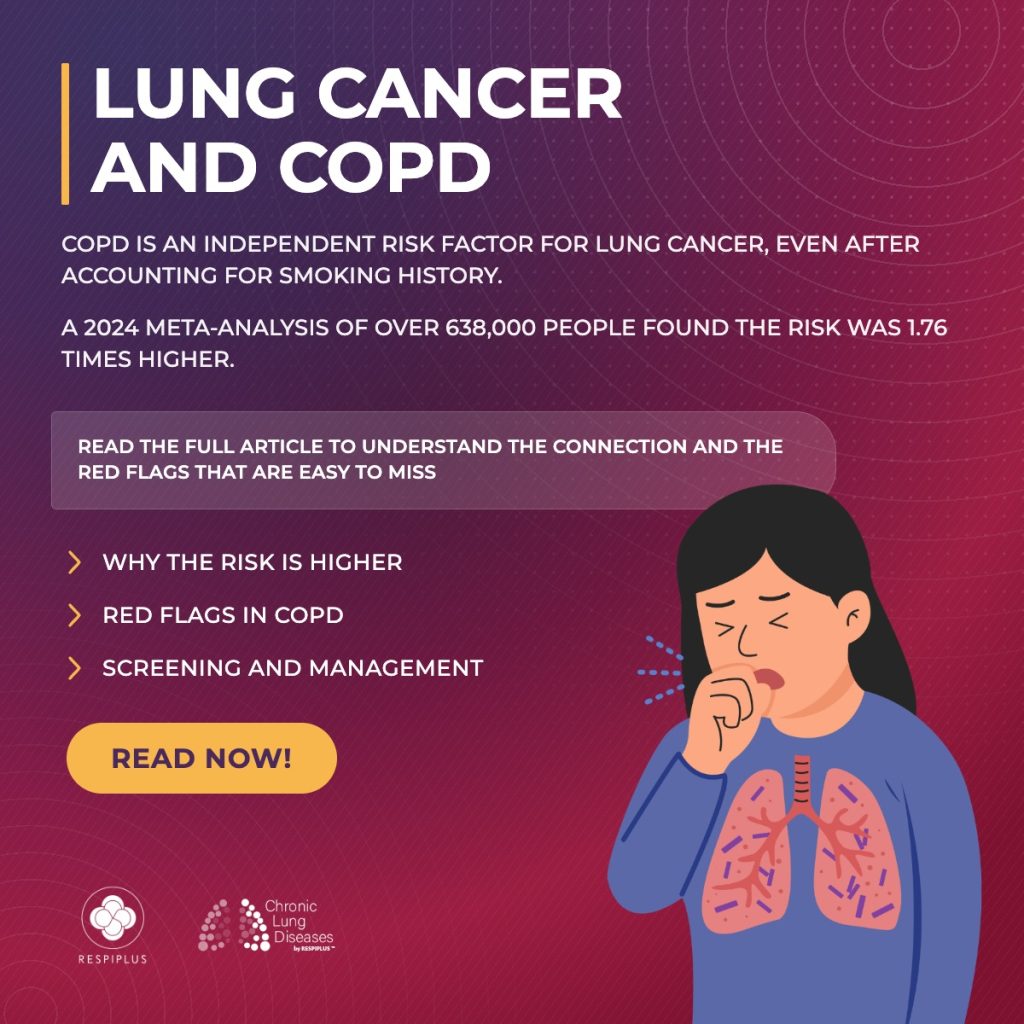
Key Takeaways
- A 2024 meta-analysis of over 638,000 people found individuals with COPD were 1.76 times more likely to develop lung cancer. Other analyses report 3 to 4 times greater risk.
- Chronic inflammation, oxidative stress, emphysema and airway remodeling are the main mechanisms linking the two conditions.
- CT-detected emphysema predicts lung cancer risk better than airflow limitation measured on spirometry alone.
- Because symptoms overlap, new or worsening changes in someone with COPD are often attributed to COPD rather than investigated.
- People with COPD and a significant smoking history are often among the best candidates for low-dose CT screening.
Table of Contents
If you have COPD, your risk of developing lung cancer is significantly higher than that of the general population. Research now confirms that COPD is an independent risk factor for lung cancer, meaning it raises risk even after accounting for smoking history, and even in people who have never smoked.
How Much Higher Is the Risk?
A large 2024 meta-analysis of over 638,000 people found that individuals with COPD were 1.76 times more likely to develop lung cancer compared to those without COPD. Other analyses have reported the risk being 3 to 4 times greater. This elevated risk persists even after controlling for smoking.
Why Does COPD Increase Lung Cancer Risk?
- Chronic inflammation is the central mechanism. COPD causes ongoing inflammation in the airways and lung tissue that damages DNA over time and can allow abnormal cells to grow.
- Oxidative stress is elevated in people with COPD, causing cellular damage that contributes to cancer-causing mutations.
- Emphysema: a form of COPD that destroys lung air sacs. It is a particularly strong predictor of lung cancer risk. CT-detected emphysema predicts risk better than airflow limitation measured on spirometry alone.
- Airway remodeling: the structural changes in COPD airways. It also creates a local environment that can promote tumor development.
Shared Risk Factors
COPD and lung cancer often share the same triggers:
- Tobacco smoking: the dominant shared risk factor for both conditions
- Occupational exposures: asbestos, silica, diesel exhaust, coal dust, arsenic
- Indoor and outdoor air pollution: including biomass burning and traffic-related pollutants
- Radon gas: the leading cause of lung cancer in non-smokers in Canada. Health Canada recommends testing your home.
Why COPD Makes Lung Cancer Harder to Detect
The symptoms of lung cancer and COPD can look identical. A worsening cough, increasing breathlessness, fatigue, and reduced exercise tolerance are common in both conditions. When these worsen in someone with known COPD, both patients and providers may initially attribute the change to COPD rather than considering a new diagnosis.
Red Flags to Watch For in a Person with COPD
- A change in a chronic cough, especially if blood is coughed up
- Breathlessness that worsens suddenly or does not respond to usual treatment
- Unexplained weight loss of more than 5 percent of body weight
- New chest, shoulder, or back pain
- Recurring chest infections
- New hoarseness
These symptoms should prompt a conversation with a healthcare provider and, where appropriate, imaging. Learn about lung cancer symptoms and diagnosis.
Screening: Who Should Be Considered?
People with COPD who have a significant smoking history may qualify for lung cancer screening using low-dose CT scans. Detecting lung cancer early dramatically improves the chances of successful treatment.
In Ontario, the Ontario Lung Screening Program accepts referrals for adults between the ages of 55 and 74 with a significant smoking history. Other provinces have their own programs. Learn about lung cancer diagnosis and screening in Canada.
Managing Lung Cancer in a Person with COPD
- Surgery is the preferred treatment for early-stage lung cancer, but reduced lung function from COPD may limit what is possible. A thorough pulmonary function assessment before surgery is essential.
- Radiation therapy: particularly stereotactic body radiation therapy (SBRT). It is often preferred in people with COPD because it delivers focused radiation to the tumor with less damage to surrounding lung tissue.
- Systemic treatments: chemotherapy, targeted therapy, and immunotherapy. These are generally not limited by COPD, though overall patient health always plays a role.
Close coordination between the respirology and oncology teams is essential.
For Healthcare Professionals
- A low threshold for imaging is warranted when a COPD patient presents with new or changing symptoms that cannot be explained by their current management plan.
- Screening program eligibility should be assessed for all COPD patients with a significant smoking history. These patients are often among the highest-risk individuals in a general respiratory practice.
- CT-detected emphysema is a stronger predictor of lung cancer risk than FEV1 or FEV1/FVC alone. When emphysema appears on CT done for any reason, this should inform monitoring conversations.
- Comprehensive molecular testing should be completed in all NSCLC patients with COPD. COPD does not change the biology of the lung cancer. These patients can and do develop ALK-positive NSCLC and other targetable subtypes.
Free Video Education Series
RESPIPLUS has produced a 12-part video series on ALK-positive non-small cell lung cancer for healthcare professionals, covering diagnosis, treatment selection and the day-to-day management of targeted therapy.
External Resources
Related Resources
References
Show references
- Young RP et al. Lung Cancer Risk in US Adults with COPD: A Systematic Review and Meta-Analysis. PMC 2024. PMC
- Chen W et al. Chronic Obstructive Pulmonary Disease and Lung Cancer: A Meta-Analysis of Risk Association. PMC 2022. PMC
- Kiri VA et al. Chronic obstructive pulmonary disease and risk of lung cancer: a meta-analysis of prospective cohort studies. PMC 2017. PMC
- Kang MJ et al. Inhaled Corticosteroids and the Risk of Lung Cancer in COPD Patients: A Systematic Review and Meta-Analysis. PMC 2022. PMC
- Canadian Cancer Society. 5 Facts About Lung Cancer in Canada. 2023. cancer.ca
- Statistics Canada. Lung Cancer is the Leading Cause of Cancer Death in Canada. statcan.gc.ca
- NHS. Lung Cancer. Causes. nhs.uk
About this article
Written by Katrina Metz, RT, respiratory therapist and medical writer at RESPIPLUS. Medically reviewed by Dr. Claudia LeBlanc, MD, Senior Scientist at Princess Margaret Cancer Centre and a leading Canadian expert in ALK-positive NSCLC management.
About this project
This series was supported by Pfizer and developed independently by RESPIPLUS with the CARMA-BROS network. Scientific Committee: Dr. Geoffrey Liu (Princess Margaret), Maria Sedeno (RESPIPLUS), Emily Horvat (RESPIPLUS), Katrina Metz (RESPIPLUS), Christopher Deutschman (CARMA-BROS), Faisal Al Agha (CARMA-BROS). All materials are free and permanently hosted on chroniclungdiseases.com.
Published August 4, 2026. Last reviewed . For educational purposes only. Not a substitute for medical advice.