

Alpha-1 Antitrypsin Deficiency - General Information
Understanding Alpha-1 Antitrypsin Deficiency: Testing, Diagnosis, and Treatment
Alpha-1 Antitrypsin Deficiency (AATD) is one of the most common serious inherited conditions in the world, but it is often missed. It happens when the body does not make enough of a protein called Alpha-1 Antitrypsin (AAT). This protein normally protects the lungs from damage. Without enough of it, the lungs can be slowly and permanently harmed.
Even though AATD is a known genetic cause of COPD, it often goes undetected for years. Many people with the condition are told they have COPD without anyone checking for the underlying genetic cause. This page brings together four educational articles from Respiplus to help patients, caregivers, and healthcare professionals learn more about AATD, from testing to treatment and family screening.
Explore the full series below
What Is Alpha-1 Antitrypsin Deficiency?
AATD is a genetic condition that you inherit from your parents. It means the body does not make enough of the AAT protein. AAT is produced in the liver and then travels to the lungs, where it protects the lung tissue from damage.
Think of AAT as a shield. When there is enough of it, the lungs are protected. When levels are too low, that protection is not there from birth. The lungs are most affected, but in some cases the liver can be affected too.
How AATD Causes Lung Damage
Healthy lungs contain enzymes that are part of the body’s normal defence system. AAT keeps these enzymes under control so they do not harm the lungs. One of the main enzymes involved is called neutrophil elastase.
When there is not enough AAT, these enzymes can damage the small air sacs in the lungs. Over time, this leads to a condition called emphysema. Smoking and exposure to dust or chemicals at work can speed this process up considerably. The damage builds up over time and cannot be reversed, which is why finding AATD early matters.
Why AATD Is Frequently Underdiagnosed
Many people with AATD are not diagnosed for years, even decades. During that time, the lungs continue to be damaged without anyone knowing the real cause.
This happens for a few reasons. AATD looks a lot like regular COPD, so doctors may not think to test for it. Testing is not always done as part of a standard COPD checkup. Young people and non-smokers with breathing problems are especially at risk of being missed.
Who Should Be Tested for Alpha-1 Deficiency
Guidelines recommend that everyone diagnosed with COPD should be tested for AATD, no matter their age or whether they smoke. Testing is also recommended for people with unexplained emphysema, asthma that does not improve with standard treatment, or unexplained liver disease.
The test is a simple blood test that checks AAT protein levels. If levels are low, a genetic test can identify which gene variants are present. The test is easy to do, but many people still do not get tested.
Treatment Options: From Early Detection to Augmentation Therapy
Finding AATD early opens up more options for care. Stopping smoking, getting vaccinated, and avoiding lung irritants at work all become more targeted steps when you know AATD is involved.
For some patients, a treatment called augmentation therapy is available. It involves regular IV infusions of AAT protein to help protect the lungs and slow down damage. Starting this treatment before the lungs are seriously affected tends to lead to better outcomes. Whether someone qualifies depends on their genetic type, lung function results, and overall health.
This content is for educational purposes and does not replace medical advice.
The Importance of Family Screening After an AATD Diagnosis
Because AATD runs in families, a diagnosis in one person has implications for their relatives. Parents, brothers, sisters, and children may all carry the same genetic variants.
Cascade testing means checking family members one by one after a diagnosis is confirmed. Finding at-risk relatives before they develop symptoms gives them a chance to monitor their health early, make lifestyle changes, and access treatment sooner if needed. These conversations can be emotionally difficult, and healthcare professionals can play an important role in helping patients navigate them.
Alpha-1 Education Series: Four Articles to Guide You
The following articles form a connected learning journey on Alpha-1 Antitrypsin Deficiency. Each can be read independently, but they are designed to build on one another.
Why Every Person with COPD Should Be Tested for Alpha-1 Antitrypsin Deficiency
Most people living with COPD have never been tested for AATD, even though clinical guidelines recommend it. This article examines why Alpha-1 testing remains underutilized and what stands to be gained when testing becomes a standard part of COPD care.
You’ll learn about:
- Why current clinical guidelines recommend AATD testing for all people with COPD
- The diagnostic gap between guideline recommendations and clinical practice
- How AATD testing is performed and what results mean
- Why identifying AATD changes the approach to patient management
What Alpha-1 Antitrypsin Deficiency Really Is and Why Early Diagnosis Matters
A clear understanding of AATD, its genetics, its mechanisms, and its clinical course, is essential for both professionals and patients. This article provides an accessible and accurate overview of the condition and explains why catching it early makes a meaningful difference.
You’ll learn about:
- How AATD is inherited and who is at risk
- How AATD damages the lungs
- Why AATD is frequently mistaken for other respiratory conditions
- The clinical significance of early versus late diagnosis
Augmentation Therapy: Why Waiting After an Alpha-1 Diagnosis Hurts
Once AATD is diagnosed, one of the key clinical questions is whether augmentation therapy is appropriate and when to start. Delaying treatment can have consequences that are difficult to reverse. This article explores the evidence and the clinical reasoning behind starting as soon as possible .
You’ll learn about:
- What augmentation therapy is and how it works in AATD management
- The evidence supporting its use in eligible patients
- Why delays in initiating therapy can accelerate lung function decline
- How to approach the treatment conversation with patients
Alpha-1 Family Testing: Who Should Be Screened and Why
Because AATD is hereditary, a diagnosis in one family member has implications for others. Family screening can identify at-risk relatives before symptoms appear, offering an opportunity for early monitoring and intervention. This article explains the case for cascade testing and how to facilitate it in practice.
You’ll learn about:
- How AATD is passed from parent to child and the inheritance patterns involved
- Which family members should be considered for screening after a diagnosis
- The practical and emotional dimensions of family-based genetic testing
- How healthcare professionals can support patients in navigating these conversations
Key Takeaways
- Alpha-1 Antitrypsin Deficiency (AATD) is a hereditary condition that significantly increases the risk of developing COPD and emphysema.
- AATD is widely underdiagnosed; years commonly pass between symptom onset and a correct diagnosis.
- Clinical guidelines recommend that all people living with COPD be tested for AATD, regardless of their clinical history.
- Early diagnosis increases management options and may slow the progression of lung damage.
- Augmentation therapy is available for eligible patients, and it is important to start as soon as possible.
- A confirmed AATD diagnosis should encourage family screening to identify at-risk relatives before significant disease develops.
Authors
Jean Bourbeau, MD, MSc, FRCPC
Angela Diano, Executive Director, AlphaNet Canada
Katrina Metz, RT
Maria Sedeno, BEng, MM, GCSRT (Harvard)
Frequently Asked Questions (FAQ) about Alpha-1 Antitrypsin Deficiency (AATD)
What is Alpha-1 antitrypsin deficiency (Alpha-1)?
Alpha-1 is an inherited condition where the body has too little functional alpha-1 antitrypsin, a protective protein made mainly in the liver. This protein helps protect lung tissue from inflammation-related damage. When levels are low, lung damage can build slowly over years and cause COPD. Some people also develop liver problems because abnormal protein can build up in the liver.
What does alpha-1 antitrypsin do in the body?
Alpha-1 antitrypsin acts like a protective shield for the lungs. During infections, smoke exposure, or irritation, inflammation enzymes can damage healthy lung tissue. Alpha-1 helps keep that damage in check. Without enough functional protein, the lungs are more vulnerable to cumulative injury, which can lead to early emphysema or COPD-like changes. In some forms of Alpha-1, protein can also stress the liver.
How common is Alpha-1 and why is it often missed?
Alpha-1 is one of the most common inherited conditions linked to COPD, but it is still underdiagnosed. It is missed because symptoms overlap with asthma and COPD, and smoking history can distract from genetic causes. Many people are diagnosed only after years of symptoms or repeated exacerbations. A simple blood serum level test can diagnose Alpha-1 earlier and change the care plan.
Can you have Alpha-1 if you have smoked, or if you feel fine?
Yes. Smoking does not cause Alpha-1, but it can accelerate lung damage in people who have it, even with a relatively small smoking history. Some people with Alpha-1 have few or no symptoms for years, especially if they avoid smoking and reduce exposures. That is why family testing and early detection can matter: it supports prevention before major lung function is lost.
Does Alpha-1 only affect the lungs?
No. Alpha-1 can affect the liver because abnormal alpha-1 protein may build up in liver cells instead of being released into the bloodstream. Some people develop elevated liver enzymes, fibrosis, cirrhosis, or other liver complications. Not everyone with Alpha-1 will have liver disease, and severity varies by genetic type and other factors. Clinicians may monitor liver health as part of overall care.
What are the most important things to consider in Alpha-1 testing for COPD?
Start with the simplest goal: do not miss a genetic contributor to lung damage. Alpha-1 testing is usually a serum blood level first, followed by confirmatory testing if low. Key context includes age at diagnosis, smoking or exposure history, rate of progression, and family history of lung or liver disease. These details affect how strongly results change the plan.
Who should get Alpha-1 testing when COPD is diagnosed?
Many professional associations, such as the Canadian Thoracic Society, encourage testing in all people with COPD because the clinical “look” can be misleading. It is especially important in early onset COPD (often under 45 to 50), never-smokers, disproportionate emphysema, frequent exacerbations, or faster-than-expected decline. Testing once can prevent years of treating symptoms without addressing the driver.
Is Alpha-1 testing a blood test or a genetic test?
Usually both, in sequence. The first step is commonly a serum alpha-1 antitrypsin level, a standard blood test. If the level is low (or suspicious), confirmatory testing may include phenotype or genotype testing, which clarifies the specific inherited variants. The practical point: the blood test is a simple screen, genetics helps confirm and guide family discussions.
Checklist: What should happen after a low Alpha-1 level?
- Refer to respirology (or a clinician experienced in Alpha-1 who will confirm the diagnosis)
- Review lung function and imaging trends
- Discuss smoking avoidance and exposure reduction
- Consider family testing options and confidentiality
This depends on local pathways and the severity of symptoms, but the sequence above keeps care organized and timely.
What common mistakes lead to missed Alpha-1 in COPD?
A big one is assuming smoking history rules it out. Another is skipping testing because the patient is “too old” or “does not look genetic.” Alpha-1 can present across a wide range, and environmental exposures can accelerate decline. A third mistake is stopping after a single borderline result without confirmatory testing when clinical suspicion is high.
Should family members be tested if someone is diagnosed with Alpha-1?
Often, yes, but the approach should be careful and consent-based. Because Alpha-1 is inherited, first-degree relatives may want testing to understand risk and make earlier health choices. What it depends on: family planning concerns, privacy, insurance or employment worries, and emotional readiness. The best conversations are clear, non-alarmist, and centered on choice.
Do you need a specialist to order Alpha-1 testing?
Not usually. A primary care clinician can often order the initial serum test as part of a COPD workup. Specialist involvement becomes most useful when levels are low, confirmatory testing is needed, symptoms are progressing, or advanced management decisions are on the table. The fastest route is often: screen in primary care, confirm and plan with respirology.
Useful Resources
- Living Well with COPD – AATD Module (free) https://chroniclungdiseases.com/register
- Plasma Week www.plasmaweek.org
- Alpha-1 www.alpha1.org
- PPTA Global www.PPTAGlobal.org
- AlphaNet Canada https://alphanetcanada.ca/
- Canadian Thoracic Society AATD Guidelines https://www.tandfonline.com/doi/full/10.1080/24745332.2024.2443178
- AATD Podcast Series: Season 5 https://chroniclungdiseases.com/en/the-expand-podcast-season-5-aatd/
Sponsor Acknowledgement
RESPIPLUS™ received support from Takeda to develop this series specifically tailored to Alpha-1 antitrypsin deficiency (AATD).
Further Reading: More About Alpha-1 Antitrypsin Deficiency
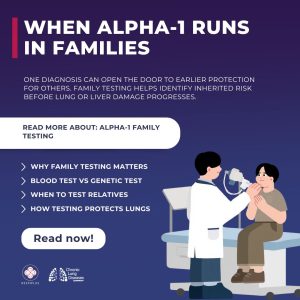
Alpha-1 Family Testing: Why It Matters
Alpha-1 family testing helps identify inherited risk early. Learn how simple blood screening can protect lung and liver health.

Augmentation Therapy: Why Waiting After Alpha-1 Hurts
Augmentation therapy is the only Alpha-1 treatment that targets the deficiency. Learn why timing matters, what it does, and what happens next.

Alpha-1 Diagnosis: What It Is and Why Timing Matters
Alpha-1 diagnosis explains genetic COPD risk. Learn what Alpha-1 is, how it damages lungs, and why early testing protects long-term lung health.